ESTRI IN PRACTICE
Use Cases
Where explainable readiness becomes the operating layer for critical workforce decisions. ESTRI replaces fragmented, narrative-driven talent processes with governed, evidence-based decision infrastructure — making workforce choices defensible under scrutiny.
Category Leadership
Why TalentGuard Owns the Category
Why TalentGuard Owns the Category
ESTRI works because TalentGuard embeds trust mechanics into the system itself — not as a feature set, but as operating infrastructure.
The Key Distinction
TalentGuard operationalizes Skill Trust and Readiness Intelligence as a system — not a feature set. Every capability is interconnected, auditable, and designed to produce defensible outcomes.
Embedded Trust Mechanics
√ Role-first standards
Proficiency scaffolding built from role architecture, not generic taxonomies.
√ Evidence and provenance tracking
Skills Ledger captures observable evidence behind every skills claim.
√ Explainability layer
Decision trace views surface logic behind every readiness determination.
√ Governance controls
Approvals, versioning, and audit trails built into the standard lifecycle.
√ Human-in-the-loop adjudication
Structured workflows that preserve human judgment at critical decision points.
√ Policy and threshold enforcement
Configurable rules that align decisions with enterprise standards and risk tolerance.
√ Segmented visibility and privacy controls
Role-based access governing who sees what, and when.
√ Closed-loop outcome measurement
Feedback mechanisms that connect decisions to measurable workforce outcomes.
Built for High-Stakes Decisions
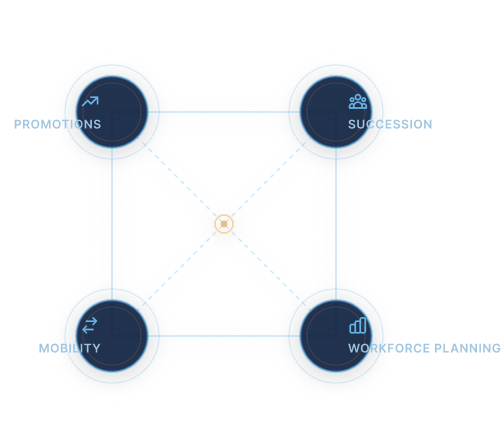
ESTRI is purpose-built for the moments where workforce decisions carry the most consequence.

Promotions
“Why this person?”
Traceable rationale and consistent criteria across every promotion decision.

Succession
Who is ready now vs. next?
Readiness bands, risk signals, and eligibility logic across the leadership pipeline.

Mobility
Who can we deploy quickly?
Eligibility determination and time-to-readiness measurement for rapid redeployment.

Workforce Planning
Where is risk concentrated?
Readiness coverage and role variance signals surfaced across the organization.
Promotions
What’s at Stake
Promotion decisions are the most frequently challenged decisions in any company. An employee who was passed over asks why. A board member asks why one VP was elevated over another. A plaintiff’s attorney asks whether the criteria were applied consistently. When the answer is “leadership felt they were ready,” the organization is exposed. This is not because the decision was necessarily wrong, but because it cannot be defended with a structured record.
How ESTRI Handles It
ESTRI turns every promotion into a traceable decision. The role standard defines what “ready” looks like at the next level. The evidence against that standard — verified proficiency, multi-rater feedback, development history, performance outcomes — is captured as the decision is made, not reconstructed afterward. When the decision is challenged, the answer is not a narrative. It’s a record.
Which Modules Operationalize This
Intelligent Role Studio defines the role standard the promotion is evaluated against. Talent Assessment establishes verified proficiency. 360 Feedback adds multi-rater evidence. Performance Management supplies outcome data. Talent Insights aggregates the evidence into the retrievable decision trace.
⊙ Customer Example
Vonachen reports an 80% increase in internal promotion acceleration and 98% retention of promoted managers after replacing fragmented Excel-based talent tracking with governed Skill Trust.
Succession
What’s at Stake
Most succession plans are wishful thinking in a spreadsheet. They contain a list of names next to critical roles, updated annually, and largely unusable when a key leader exits unexpectedly. The cost of the gap is real: prolonged interim leadership, external searches that take six to nine months, and strategic execution that stalls because no one has the combination of role knowledge and organizational context to step in.
How ESTRI Handles It
ESTRI replaces the succession spreadsheet with a governed readiness pipeline. Every critical role has a defined standard. Every candidate is assessed against that standard with verified evidence. Readiness is expressed in bands such as “ready now,” “ready 1-2 years,” “developmental” and with the logic behind each designation visible and defensible. When a leader exits, the pipeline is not a guess. It’s a documented state.
Which Modules Operationalize This
Succession Planning holds the governed bench state. Talent Assessment establishes candidate proficiency against the role standard. Development Planning closes the gaps that move a candidate from “ready next” to “ready now.” Intelligent Role Studio governs the role standards the bench is assessed against.
⊙ Customer Example
NHMB strengthened talent across bank affiliates by establishing governed succession readiness across a distributed workforce where leadership continuity is a regulatory concern.
Mobility
What’s at Stake
When a critical project launches, a regulatory deadline shifts, or a business unit needs rapid reinforcement, the instinct is to hire externally. This is because the organization cannot see, quickly enough, who inside could actually step in. The cost is not just external recruiting fees. It’s the missed internal career opportunity, the time lost to onboarding someone new to the business, and the disengagement of employees who would have been ready if anyone had measured them.
How ESTRI Handles It
ESTRI makes internal readiness visible and deployable. Employees are matched against role standards through governed readiness logic, not informal networks or incomplete skills profiles. Time-to-readiness is measurable and leaders can see not just who is ready today but who could be ready in 30, 60, or 90 days with targeted development. The answer to “who can we deploy?” is returned in hours, not weeks of informal conversations.
Which Modules Operationalize This
Career Pathing maps skill-based mobility opportunities across the organization. Talent Assessment establishes verified proficiency. Development Planning quantifies time-to-readiness for candidates who are close but not yet deployable. Intelligent Role Studio governs the role standards that make cross-functional matching reliable.
⊙ Customer Example
ENFRA used TalentGuard to drive digital transformation in across the organization identifying and deploying internal talent against emerging role standards at enterprise scale.
Workforce Planning
What’s at Stake
Strategic workforce planning is often the last place a CHRO can deliver a defensible answer. Boards ask whether the workforce can execute on strategy. Executive committees ask where critical skills are scarce. Auditors ask whether readiness risk is quantified. The answer is typically assembled from multiple spreadsheets, manager opinions, and retrospective data, which arrives too late to inform the decisions it should be shaping.
How ESTRI Handles It
ESTRI makes workforce risk measurable in near-real time. Readiness coverage across critical roles is a number, not an opinion. Role standard variance across business units is visible. For example, if Finance in North America is assessing “Senior Controller” against one standard and EMEA is using another, the variance is surfaced rather than hidden. Workforce planning decisions — where to invest in development, where to hire externally, where to consolidate — are made against governed data, not inferred from lagging indicators.
Which Modules Operationalize This
Talent Insights aggregates readiness and variance signals across the workforce. Intelligent Role Studio governs the role standards that make cross-unit comparison reliable. Certification Tracking adds compliance-relevant readiness for regulated roles. WorkforceGPT maintains the role and skills data quality that makes organization-wide planning viable at enterprise scale.
⊙ Customer Example
Vonachen reduced job and skills management effort by 90% — making the governed workforce data that underlies strategic planning economical to maintain at enterprise scale.
ESTRI Use Cases Across Industries
Financial Services
- Promotions into regulated roles (SVP Risk, Chief Compliance Officer) where decision rationale must withstand board-level scrutiny
- Succession readiness for relationship-dependent revenue roles where loss of institutional knowledge creates measurable client attrition risk
- Internal mobility from legacy operations into digital banking functions — with time-to-readiness quantified to support transformation timelines
Healthcare
- Clinical leadership succession where patient safety outcomes depend on verified clinical + operational proficiency, not just credentials
- Workforce planning across nursing tiers where readiness gaps translate directly to staffing risk and accreditation exposure
- Mobility from clinical practice into administrative leadership — matching candidates against hybrid role standards that most HRIS systems cannot govern
Manufacturing
- Promotions into plant leadership where multi-disciplinary proficiency (safety, operations, quality) must be verified against unified role standards
- Succession planning for roles tied to ISO certification or equipment-specific expertise, where governance prevents knowledge-loss risk
- Workforce planning for manufacturing digital transformation — identifying employees who can upskill from mechanical engineering into automation/robotics roles, with readiness timelines that inform capital deployment decisions
Technology & Software
- Promotions into engineering leadership (Director+) where evidence must show verified technical depth + team-scaling capability — not just peer nomination
- Internal mobility from product management into technical program management, matched against role standards that span business acumen and technical fluency
- Workforce planning for cloud migration or AI integration initiatives, where readiness coverage determines whether the organization builds, buys, or waits
Insurance
- Promotions into underwriting leadership where decision authority must be supported by verified risk assessment proficiency and regulatory knowledge
- Succession for actuarial roles where bench readiness determines whether the organization can sustain critical pricing and reserving functions
- Workforce planning across claims operations, where mobility from claims adjuster to claims leadership depends on governed evidence — not tenure
When Promotion Decisions Are Challenged
When talent decisions enter litigation, the question is not whether the decision was correct. The question is whether it can be explained with structured evidence.
In Mobley v. Workday, the plaintiff challenged a promotion decision on the basis that the criteria were applied inconsistently. The organization’s defense rested on manager attestation and retrospective narrative — not on a governed record of how readiness was determined, what evidence informed the decision, or whether the standard was applied uniformly across candidates.
The exposure was not the promotion itself. It was the absence of a decision trace.
ESTRI captures the logic behind promotion decisions at the moment they are made — role standard applied, evidence considered, readiness determination recorded. When a decision is challenged, the answer is not a reconstruction. It’s a retrievable record.
Make Workforce Decisions Defensible
See how ESTRI turns Skill Trust into explainable readiness — and makes promotion, succession, mobility, and planning decisions withstand scrutiny.