Talent Insights
If You Can’t Measure It,
You Can’t Govern It.
TalentGuard gives enterprises the first governed framework for measuring skill trust, workforce readiness, and decision defensibility — in one auditable system.
Traceable to governed source data risk
Verified records across workforce
Gap closure benchmark
Aligned across assessments
THE MEASUREMENT GAP
Your HRIS Has Reports. Your Business Needs Intelligence.
There is a meaningful difference between data that describes workforce activity and data that measures workforce readiness. Most enterprise HR systems — HRIS, BI tools, LMS dashboards — deliver the former. They tell you who completed training, how many roles are filled, and what the headcount looks like by department.
None of that tells you whether your workforce is capable of doing what your strategy requires.
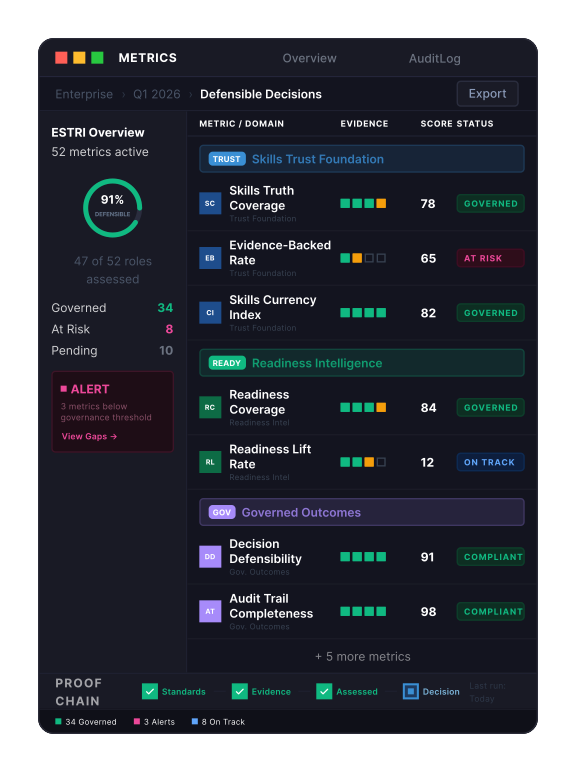
Talent Insights closes that gap. Built on TalentGuard’s ESTRI framework, it produces three categories of measurement that no standard reporting tool delivers: skills data you can trust, readiness you can quantify, and decisions you can defend.
| Standard HR Reporting | Talent Insights (ESTRI) | |
|---|---|---|
| What it measures | Activity & headcount | Skills trust & role readiness |
| Data source | HRIS transactions | Governed, multi-source evidence |
| Decision support | Descriptive (“what happened”) | Prescriptive (“what to do”) |
| Auditability | Log-level records | Full decision evidence chain |
| Workforce planning input | Headcount models | Readiness distribution + gap velocity |
| Board / legal defensibility | Limited | By design |
THE SOLUTION
Workforce Readiness Metrics — Precisely Defined, Operationally Measured
Talent Insights is TalentGuard’s analytics and measurement product — the layer of the platform where skills data becomes visible, quantifiable, and decision-grade. It operates on data governed by the Intelligent Role Studio and validated through TalentGuard’s talent applications, producing a real-time view of workforce readiness across three structured measurement categories.
It is not a dashboard. It is not a self-reported skills inventory. It is a governed measurement system — designed so that every metric has a defined source, a documented calculation, and a traceable connection to the talent decisions it informs.
Quantifies workforce readiness against actual role requirements — who is ready, at what distribution, how quickly gaps are closing, and what trajectory the workforce is on.
The 10 ESTRI Metrics
10 Metrics. Three Categories. One Governed View of Workforce Readiness.
2 Enterprise Outcome Metrics
explainable, and auditable skills evidence.
and workforce readiness quality.
Each ESTRI metric is precisely defined, operationally measured, and mapped to enterprise risk or opportunity. Expand any metric to access its full technical specification and interpretation guide.
The foundational layer of ESTRI. Measures whether the skills data an enterprise holds is complete, evidence-backed, current, and standardized — the precondition for all downstream decisions.
The percentage of active roles in the enterprise that have a complete, validated skills profile tied to a governed role standard.
The percentage of skill records that are supported by at least one qualifying evidence artifact: formal assessment result, verified credential or validated manager attestation.
The proportion of critical skill records that have been refreshed, re-validated, or re-assessed within the defined currency window relative to the skill’s role criticality rating.
Quantifies the state of workforce preparedness against actual role requirements — measuring not just who has skills, but who has the right skills, at the right level, closing gaps at what rate, and in what time.
A measure of semantic and structural divergence between role skill profiles across business units — indicating the degree to which the enterprise is operating on fragmented, non-interoperable role definitions.
The percentage of employee skill records where data signals from multiple assessment sources (self-assessment, manager validation, formal assessment, credential verification) are in substantive agreement.
The percentage of formal talent decisions (promotion, deployment, succession, development assignment) that are linked to a complete, auditable skills evidence chain in the TalentGuard system.
Validates that the skills intelligence produced by ESTRI translates into decisions that are traceable, auditable, and defensible — closing the loop from data governance to organizational accountability.
The percentage of employees who have undergone a current, validated readiness assessment against the skill requirements of their primary role.
The quarter-over-quarter percentage improvement in composite readiness scores across the assessed workforce population — measuring the effectiveness of skill development investment.
The median number of days required for an employee to progress from identified skill gap to validated role readiness, as measured across all active development assignments.
What ESTRI Enables Across the Enterprise
ESTRI is not a reporting tool. It is an enterprise governance capability. These are the specific, measurable outcomes organizations achieve when skills truth replaces skills assumption.

Replace ad-hoc talent processes with a governed, documented decision trail. ESTRI enables organizations to demonstrate that every promotion, deployment, and succession decision is backed by evidence — not intuition.

In environments where talent decisions face legal scrutiny — promotion fairness — ESTRI provides the foundation that demonstrates decisions were based on validated skills, not bias.

ESTRI converts readiness intelligence into a plannable asset. Organizations can model workforce scenarios with known distributions, gap closure timelines, and mobility pipeline depths.

Move beyond “high potential” designation-based succession to a model where candidate readiness is assessed, evidenced, and continuously updated. ESTRI makes pipelines measurable and defensible.

Connect every learning program dollar to a measurable change in workforce readiness. Readiness Lift Rate provides the enterprise with a governed, quarterly measure of whether development investment is producing role-relevant capability.

ESTRI produces a unified, reconciled skills record that replaces the multi-system fragmentation most enterprises operate on. One governed source of truth — cross-referenced, evidence-backed, and continuously current.
Intelligence Is Only Valuable When It Drives What Happens Next.
Talent Insights is not the end of the workflow. It is the signal layer that tells the rest of the TalentGuard platform — and your talent leaders — where to act, where to intervene, and where the enterprise is exposed.
Intelligent Role Studio Applications (Governed Skills Data) Role standards Evidence records Assessment results Planning | → | Talent Insights (Measurement Layer) Skills Trust Foundation Readiness Intelligence Governed Outcomes | → | Talent (Action Layer) Talent Assessment Development Plans Succession Career Pathing |
What “Good” Looks Like — ESTRI Benchmark Reference
The following benchmarks represent observed performance ranges across TalentGuard enterprise deployments. They are intended as directional reference points for organizations establishing baseline ESTRI metrics.
| Metric | At-Risk Threshold | Developing Range | Governed Standard |
|---|---|---|---|
| Skills Truth Coverage | < 50% of roles | 50–74% | ≥ 75% |
| Evidence-Backed Skills Rate | < 40% | 40–64% | ≥ 65% |
| Skills Currency Index | < 60% in window | 60–79% | ≥ 80% |
| Readiness Coverage | < 60% assessed | 60–79% | ≥ 80% |
| Time to Readiness | > 90 days | 47–90 days | < 47 days |
| Readiness Lift Rate | < 5%/quarter | 5–11% | ≥ 12%/quarter |
| Decision Defensibility Rate | < 70% | 70–89% | ≥ 90% |
| Audit Trail Completeness | < 85% | 85–95% | ≥ 96% |
Benchmarks are based on TalentGuard ESTRI deployments across enterprise customers. Individual baselines vary by industry, organization maturity, and program scope.