Trust and Governance
Governance Doesn’t Happen in Dashboards.
It Happens in Operations.
TalentGuard’s Trust & Governance layer defines who owns your skills standards, how decisions get approved, and what happens when someone asks you to prove it. This is the operating model behind defensible workforce decisions — not a feature. A discipline.
The Difference Between Governance and Reporting
Most platforms report on talent data. TalentGuard governs it. Reporting tells you what happened. Governance creates the conditions under which what happened can be explained, justified, and repeated — consistently, across roles, regions, and business cycles. When a promotion is challenged, a succession decision is scrutinized, or a regulator requests documentation, reporting cannot help you. Governance already has.
CAPABILITIIES
How Governance Actually Works at TalentGuard
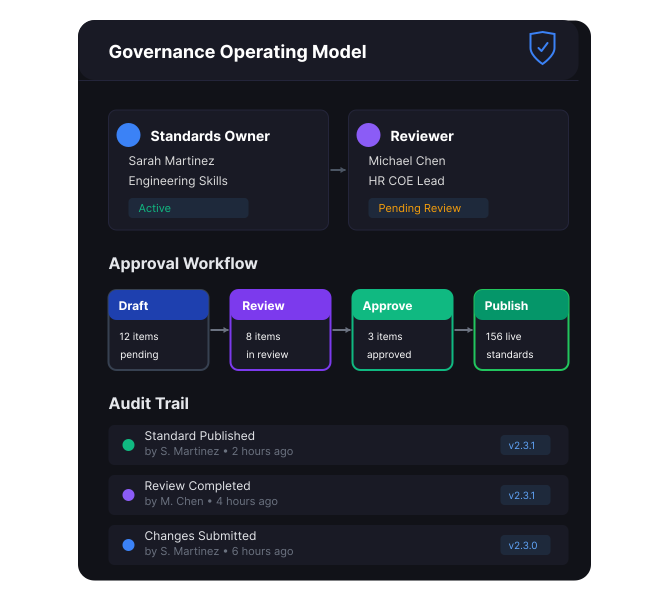
Governance in TalentGuard is not a compliance checkbox. It is a structured operating model with defined roles, approval flows, and documented rationale — built into the platform from the start.
 Ownership and Stewardship
Every role and skill in TalentGuard has a named owner. Stewardship is not assigned to “HR” — it is assigned to a specific individual with accountability for roles or skill families.
- Named owners per role family
- Stewards assigned to manage review cycles
- Separation of duties between reviewers and approvers
 Approval Workflows
Before a skills standard, readiness score, or AI-generated output enters the decision environment, it passes through a structured approval workflow.
- Draft → Review → Approve → Publish is the default lifecycle
- AI-generated content requires at least one qualified human approval before it becomes decision-eligible
 Version Control & Change Management
Standards change. The governance layer ensures every change is traceable — not just recorded.
- Version history with dates for all role and skill standards
- AI-generated content requires at least one qualified human approval before it becomes decision-eligible
 Audit Trails by Design
Every talent action in TalentGuard — an assessment submission, a promotion recommendation — is time-stamped, attributed, and linked to the active standard at the time of the decision.
- The audit trail cannot be disabled, bypassed, or retroactively modified.
Governance Artifacts — The Evidence You Produce on Demand
When a talent decision is questioned — internally or externally — Trust & Governance gives you a complete, reviewable record.

Standards Reference
Which role or skill standard applied at the time the decision was made. What version was active. Who owned and approved it.

Evidence Snapshot
The specific assessment results, credentials, manager validations, and behavioral records that formed the basis of the readiness determination.

Logic Trace
The explainable path from skill standard → evidence gathered → readiness conclusion. Not a model score. A documented reasoning chain.

Consistency View
How the same standard was applied across comparable employees in the same role family — demonstrating that the decision was not arbitrary or individually biased.

Change Log
Whether the governing standard has changed since the decision was made — and if so, what changed, when, and who approved it.

Approval Record
Who reviewed and approved the standard, exception, or special determination — and when.
Establishing Governance Before You Scale
TalentGuard recommends a governance-first deployment sequence. Scaling an ungoverned skills environment produces faster decisions that are harder to defend — not a better outcome.
Establish Ownership
Define stewardship roles and approval hierarchies for your initial scope. Assign owners to role families. Configure access and separation of duties.
Anchor the Standards
Stand up the role and skill standards that will govern your first talent decisions. These are the benchmarks against which all readiness and gap data will be measured.
Activate the Evidence Discipline
Define what qualifies as evidence for each skill domain. Configure the evidence types — assessment, credential, validation — that the platform will accept.
Run the First Governed Cycle
Execute one full talent decision cycle — assessment through recommendation — under full governance. Review the artifacts. Test the audit trail. Close any gaps before expanding.
Expand and Operationalize
Scale governance standards across additional job families, regions, and use cases. Introduce review cadences, exception handling protocols, and ongoing stewardship processes.