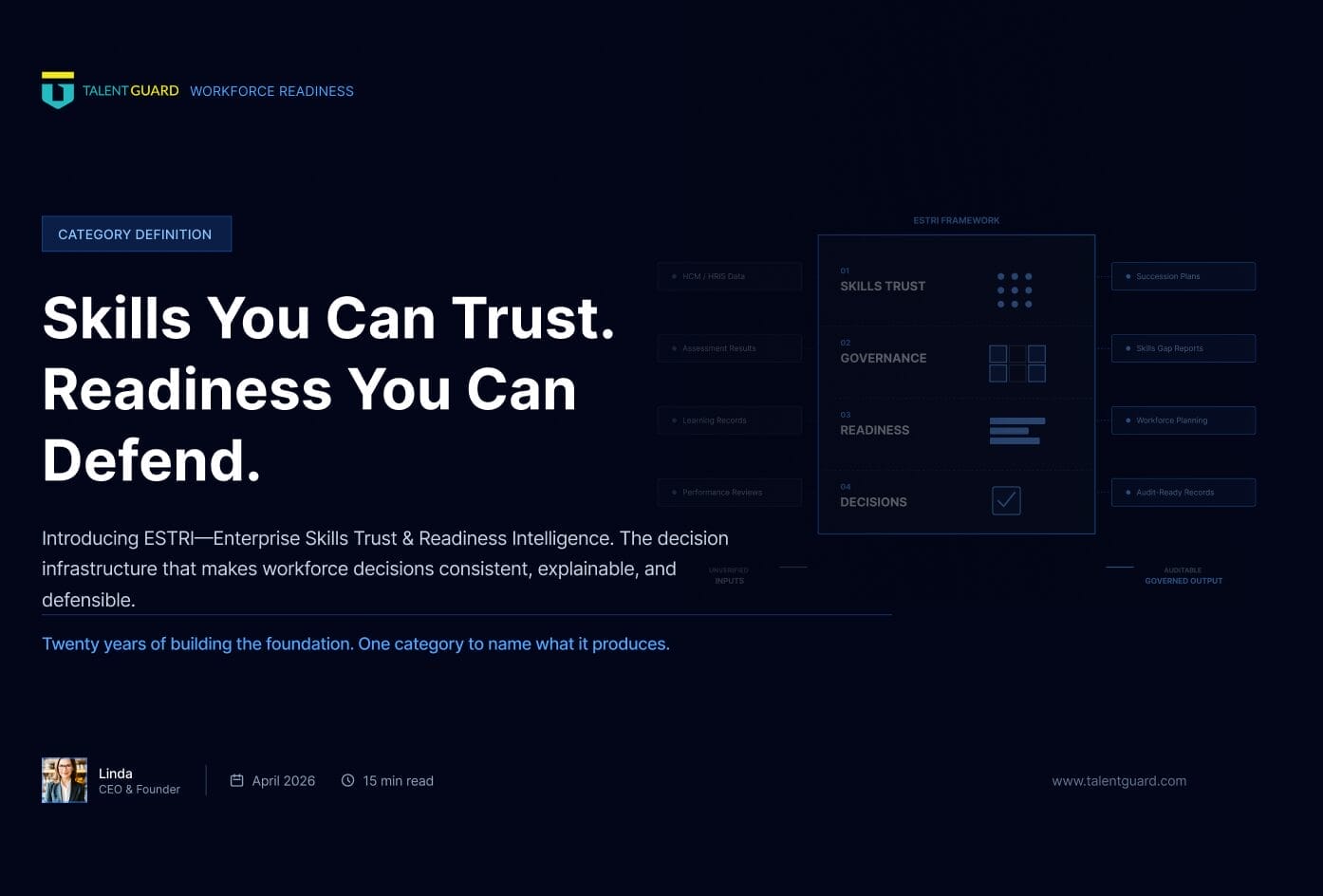
Skills You Can Trust. Readiness You Can Defend. Introducing ESTRI.
Twenty years of building the foundation. One category to name what it produces.
In my last post, I shared the story of how TalentGuard got here. The checkbox era. The career ladder with no data behind it. The deployments that stalled because the ground wasn’t what anyone believed it was. The decision to go back down and build the foundation properly– not because it was the easy path, but because it was the only one that leads somewhere real.
I told you about WorkforceGPT.ai, the tool we built to solve the job architecture problem that had been breaking workforce programs across the industry for two decades. And I shared about the transparency and traceability demand that is now arriving from every direction simultaneously. We are seeing it from employees who want to understand the system affecting their careers, from managers who need something real to stand behind and from boards and regulators who are asking questions that most organizations cannot yet answer.
If that story resonated with you, if you recognized your organization in any part of it, then what I am about to share is for you. Because everything we built across those twenty years has a name now.
The Problem Was Never A Lack Of Data
Let me be precise about what we learned, because precision matters here. The enterprises we have worked with over two decades did not fully implement their workforce programs because they lacked data. The data they had could not be trusted.
Skills inventories full of self-reported claims nobody could verify. Job architectures that looked structured until the software exposed what was actually there. Succession plans built on readiness labels that had no evidence behind them. Mobility programs that moved people into roles they were not prepared for and could not explain why they were selected or what they would need to succeed.
The gap was not visibility. Every one of those organizations had dashboards. The gap was trust. And in the absence of trust, the most important workforce decisions including promotions, succession, restructuring, redeployment had reverted to gut feel, relationships, and whoever was in the room. The data existed. Nobody believed it. That gap has a name. And closing it requires infrastructure that most talent platforms were never designed to provide.
Why This Moment Is Different From Every Moment Before It
We have been building toward this category for two decades. But three forces have converged right now that make this the moment it becomes essential rather than aspirational.
These three forces are not sequential. They are arriving together. And together, they create a new enterprise requirement that no existing talent platform was built to meet.
Introducing Enterprise Skills Trust & Readiness Intelligence
We created the category. Today we are naming it.
Enterprise Skills Trust & Readiness Intelligence — ESTRI is the decision infrastructure that makes workforce decisions consistent, explainable, and defensible. It transforms fragmented skill signals into governed, evidence-backed Skills Truth. It converts that truth into role-based readiness intelligence. And it ensures every resulting workforce decision can be explained, replayed, and defended by every person it affects and at every level it is challenged.
This is not HR analytics. It is not a talent marketplace. It is not a matching engine or a reporting layer. It is the decision layer for the workforce; the governed foundation that makes everything built on top of it trustworthy.
Skills you can trust. Readiness you can defend.
What ESTRI Is Built On
The ESTRI framework operates through four integrated pillars. Each one addresses a specific and documented failure mode in how enterprises currently manage workforce decisions. Together they form what we call the TalentGuard Decision Confidence Framework: the system that moves an organization from fragmented data to defensible decisions.
- Skills Trust is the foundation. Every skill claim in the system has a source, a date, a method, and a traceable owner. Proficiency expectations are anchored to observable behavioral indicators and not skill tags, not inference. Role definitions are standardized, versioned, and governed so that the same standard applies in every business unit, geography, and function. Skills stop being scattered data and become a managed asset, one the organization can act on with confidence and defend under scrutiny.
- The Governance Layer controls how that foundation evolves. Role lifecycle management, SME ownership models, change control workflows, policy guardrails, and segmented visibility ensure that Skills Truth stays current, consistent, and auditable as the organization changes. Without governance, skills drift. Role definitions go stale. Standards diverge across business units. And decisions made on last quarter’s truth become this quarter’s liability.
- The Readiness Engine converts governed standards into operational intelligence. Not dashboards, decisions. Who is ready for this role today? Who is ninety days away? Where are the gaps that create succession risk? Which mobility moves are evidence-backed and which are wishful thinking? The Readiness Engine answers these questions with logic that is grounded in verified evidence, role-specific standards, and a clear chain of reasoning that can be followed from beginning to end.
- Defensible Decisions closes the loop. Every determination the system produces carries a complete audit trail: data, logic, policy, approval, changes. Decisions can be replayed at the moment they were made. Rationale can be captured and exported. Outcomes can be measured and tied back to the interventions that produced them. When a decision is challenged whether by an employee, a manager, a board, or a regulator — the organization can answer clearly, completely, and with evidence.
One system. Four pillars. Built for the era when getting this wrong has real consequences.
The Principles That Define The Category
A category only matters if it sets a clear standard. ESTRI defines that standard through six principles that separate decision-grade workforce intelligence from the activity it replaces.
- Role-first. Skills are interpreted through roles, not as isolated inventories. A skill only means something in the context of what a role actually requires.
- Evidence-based. Every skill claim and readiness signal has provenance. Where did it come from? When was it validated? By whom? Through what method? Without evidence, a skill claim is an opinion.
- Explainable. Every determination can be articulated — to the employee it affects, the manager who acts on it, and the auditor who reviews it. If a decision cannot be explained, it should not be made.
- Human-in-the-loop. The organization retains accountability. ESTRI supports and informs decisions. It does not make them blindly. Governance, oversight, and human judgment are not optional layers — they are core to the system.
- Governed. Standards, ownership, and change control are explicit. Someone is accountable for every skill definition, every role requirement, every proficiency expectation. Without named accountability, standards drift.
- Auditable. Every decision can be replayed with a clear trail from data to logic to outcome. The audit is not a report that gets generated after the fact. It is a continuous record built into every determination the system makes.
If one of these principles is missing, the organization is not building Skills Trust and Readiness Intelligence. It is building activity, and calling it a strategy.
What Comes Next
ESTRI is not a big-bang transformation. The adoption path is sequential, scoped, and designed to build trust incrementally rather than declare it wholesale.
Establish Skills Trust in a defined scope. Start with a business unit, a critical role family, a function. Implement governance and role lifecycle control. Activate the Readiness Engine for the decisions that matter most. Embed action loops across development, succession, and mobility. Operationalize decision analytics and outcome measurement. Scale with enterprise-wide standards.
Skills Trust is built. Not declared.
And it is built faster now than it has ever been because WorkforceGPT.ai eliminated the job architecture bottleneck that used to make this work take years. What the industry accepted as a multi-year foundation-building exercise now takes weeks. The constraint that kept organizations from starting is gone. The only question is whether they are ready to build on what they create.
The Future is Trust-based
The future of workforce strategy is not simply skills-based. Every organization is moving toward skills-based. The ones that will win are the ones that move toward trust-based. The enterprises that will define the next decade are the ones that can say — with evidence, with governance, with full auditability — what their people can do, who is ready, and why they made the decisions they did. The ones that can answer the employee who asks why they were passed over. The board member who asks how the succession plan was built. The regulator who asks for the documentation behind the AI-assisted decision.
That is not a distant requirement. It is the present one. And it is exactly what ESTRI was built to deliver.
In the posts that follow, we will show you what this looks like in practice. We will share across industries, use cases, and the specific workforce decisions that carry the most consequence. Each one will take a real scenario and walk through what it means to make that decision on a foundation you can actually defend.
Because the category is not just a framework. It is a way of operating. And the organizations that adopt it first will not just reduce their risk. They will build something their competitors cannot replicate.
To learn more about TalentGuard’s ESTRI framework, download the white paper or point of view.
About TalentGuard
TalentGuard powers Enterprise Skills Trust & Readiness Intelligence—so organizations can make talent decisions that are consistent, scalable, and defensible. We turn fragmented skills signals into a governed Skills Truth foundation: role-based standards, proficiency expectations, evidence and provenance, and a complete change history. On top of that foundation, TalentGuard delivers explainable role readiness and gap insights—then connects action loops (development, mobility, performance, succession, and certifications) to measurable progress. The result: a trusted system of record for role and skills data that supports audit-ready reporting, stronger workforce planning, and better outcomes across the talent lifecycle.
Request a demo to see how TalentGuard helps you establish Skills Truth and operationalize readiness intelligence across your enterprise.
FAQs
What is ESTRI (Enterprise Skills Trust & Readiness Intelligence)?
ESTRI is the decision infrastructure that makes workforce decisions consistent, explainable, and defensible. It converts fragmented skill signals into governed, evidence-backed Skills Truth, turns that truth into role-based readiness intelligence, and ensures every resulting decision can be explained, replayed, and defended — to the employee it affects, the manager who acts on it, or the regulator who reviews it. It’s not HR analytics, a talent marketplace, or a matching engine; it’s the decision layer everything else sits on top of.
If organizations already had skills data and dashboards, what was actually missing?
Trust, not visibility. The data existed — skills inventories, job architectures, succession plans — but it couldn’t be relied on: self-reported claims nobody verified, readiness labels with no evidence behind them, mobility decisions no one could explain. Because the data wasn’t trusted, the most consequential workforce decisions defaulted back to gut feel and whoever happened to be in the room, dashboards notwithstanding.
Why is this becoming urgent now rather than five years ago?
Three forces are converging at the same time. Skills-based talent strategy has gone mainstream, which means unverified data no longer just sits there quietly — it actively scales decision risk. AI agents have moved from recommending to participating directly in workforce decisions, so ungoverned data fed into them produces faster versions of indefensible decisions rather than better ones. And regulatory frameworks in the US, EU, and UK have crossed the threshold from “coming” to “here,” now classifying many workforce AI applications as high-risk and requiring documentation most organizations don’t yet have.
What are the four pillars ESTRI is built on?
Skills Trust (every skill claim has a source, date, method, and owner), the Governance Layer (lifecycle management and change control that keep that foundation current as the organization changes), the Readiness Engine (translating governed standards into who’s ready for what role, and why), and Defensible Decisions (a full data-to-logic-to-outcome trail that can be replayed and audited). Together, these form what the post calls the TalentGuard Decision Confidence Framework — the path from fragmented data to decisions an organization can stand behind.
Does adopting ESTRI require a full enterprise-wide rollout to get started?
No — the post describes it explicitly as not a big-bang transformation. The path is sequential: establish Skills Trust within a defined scope (a business unit or critical role family), implement governance, activate the Readiness Engine for the decisions that matter most, embed it into development and succession workflows, then scale outward. The post also notes that WorkforceGPT.ai has removed the job-architecture bottleneck that used to make this a multi-year effort, compressing what was previously years of foundation-building into weeks.
See a preview of TalentGuard’s platform
The Confidence that Precedes the Hardest Lessons
We went underground. We stayed there until we got it right. On twenty years of building the infrastructure the workforce actually needs and what the hardest lessons taught us about what it means to finish. There is a particular kind of confidence that precedes the hardest lessons. Not arrogance. Not carelessness. Just the reasonable certainty […]
Use Case #1: Job Architecture Refresh Without the Multi-Year Death March
Most job architecture refresh efforts do not fail because the work is too hard. They fail because the work is sequenced badly. The organization tries to clean up every title, calibrate every level, rewrite every job description, and standardize every skill at once. The result is predictable: endless workshops, political debates over exceptions, consulting-heavy inventories, […]

Readiness Intelligence: Stop Reporting Skills-Start Quantifying Capability for Outcomes
Most organizations can report on skills. They can show how many employees have a skill tag, how many completed a course, how many roles mention a capability, or where demand appears to be rising. They can generate dashboards that look informative and even feel strategic. But that still leaves the question leaders actually care about […]