AI Skills Taxonomy: The Complete Guide for HR and Talent Leaders
An AI skills taxonomy is only as valuable as the trust you can place in it. Most organizations have one or at least believe they do. What they actually have is a list of skills associated with job families, maintained sporadically, interpreted inconsistently, and quietly distrusted by the HR business partners and managers who are supposed to use it to make talent decisions.
The problem is rarely the taxonomy itself. It is how the taxonomy was built, how it is governed, and whether the data connected to it can be verified. A well-structured list of skills that no one can act on with confidence is not workforce intelligence. It is a project artifact.
AI changes what is possible in skills taxonomy design and management. It can ingest signals from dozens of sources, identify emerging skills before they appear in formal frameworks, flag outdated entries, and surface gap patterns across the workforce at a scale that manual maintenance cannot match.
But AI applied to an ungoverned taxonomy does not solve the trust problem. It accelerates it. The organizations that get the most from AI in skills management are those that build the governance layer first and then use AI to operate and maintain it. This guide covers both.
What a Skills Taxonomy Is and What It Is Not
A skills taxonomy is a structured, hierarchical classification of skills organized by category, type, and relationship. It provides the common language an organization uses to describe workforce capability consistently across roles, functions, and geographies.
What a skills taxonomy is not:
- A list of job titles or job descriptions
- A competency model (though competencies may map to skills within it)
- A learning catalog or course inventory
- A performance rating scale
- An org chart with skills labels attached
The distinction matters because organizations frequently conflate these structures, and conflation produces a taxonomy that cannot serve the purpose it was designed for. A competency model describes broad behavioral patterns. A skills taxonomy describes specific, verifiable capabilities at a granular level. A course inventory describes available learning. A skills taxonomy describes what employees can do. These are different things.
The relationship between a skills taxonomy and a skills framework is also worth clarifying. The taxonomy is the structure: the organized classification of skills. The framework is the governance layer: the standards, calibration, evidence requirements, and maintenance processes that make the taxonomy trustworthy and actionable. Most organizations build a taxonomy. Fewer build the framework that makes it useful.
Why Static Skills Taxonomies Fail
A static skills taxonomy is a taxonomy built at a point in time and maintained infrequently. Most organizations have one. Most of the time, it fails them.
The maintenance gap
Skills evolve faster than manual taxonomy maintenance can track. Technology skills in particular have a half-life measured in months, not years. A taxonomy last updated eighteen months ago may accurately reflect what the workforce needed then and substantially misrepresent what it needs now. Decisions made against that taxonomy — promotion readiness, succession eligibility, development investment, internal mobility matching — are built on a decaying foundation.
The consistency problem
Manual taxonomy maintenance degrades consistency over time. Proficiency levels defined by one team are interpreted differently by another. Role requirements written by one HR business partner do not align with requirements written by their colleague in a different function. Skills that appear in one part of the taxonomy overlap with skills in another under different names. The result is a taxonomy that looks comprehensive and functions as noise.
The provenance gap
Most static taxonomies contain skills with no documentation of source, validation method, or recency. A skill appears in the taxonomy because someone decided it should be there. Whether that decision reflected external market data, internal job analysis, SME validation, or a manager’s opinion is not recorded. That missing provenance makes every downstream decision uncertain: was this skill requirement validated, or was it a guess?
The disconnection problem
A taxonomy that exists in a separate system from performance management, learning, succession, and mobility does not function as intelligence infrastructure. It functions as a reference document that practitioners consult when they remember it exists. Skills data that does not connect to decisions does not produce outcomes.
AI Skills Taxonomy – What is Possible?
AI addresses the maintenance gap, the consistency problem, and the disconnection problem in specific ways. It does not address the provenance gap. That requires human governance.
Automated signal ingestion
AI can pull skills signals from multiple sources simultaneously: job postings, learning management system completion records, certification databases, project management systems, performance records, and external market data. This continuous ingestion keeps the taxonomy current in ways that manual review cycles cannot.
The important caveat: ingesting signals is not the same as validating them. AI can identify that a skill is appearing frequently in external job postings and flag it for taxonomy inclusion. It cannot determine whether that skill is relevant to your organization’s specific context, how it relates to existing taxonomy entries, or at what proficiency level it should be required for which roles. Those determinations require human judgment.
Emerging skills detection
AI can identify skills gaining market traction before they appear in formal HR frameworks. By analyzing job posting data, professional community signals, and industry certification trends, AI can surface emerging capabilities and give HR teams enough lead time to assess relevance, define proficiency standards, and update role requirements before the gap becomes critical.
Pattern recognition at scale
AI can analyze skills data across a large workforce to identify patterns that are invisible at the individual level: clusters of employees with similar gap profiles, roles where skills requirements consistently exceed workforce supply, functions where specific certifications are concentrating, and trajectory patterns that predict which employees are developing toward which roles.
Taxonomy maintenance support
AI can flag taxonomy entries that may be outdated based on market signal changes, identify skills that appear to overlap or duplicate each other, and surface inconsistencies across role definitions. This maintenance support does not replace human review. It makes human review more efficient by surfacing what needs attention rather than requiring practitioners to inspect the entire taxonomy periodically.
What AI cannot do
AI cannot validate that a skills claim is accurate. It cannot determine that a proficiency level is calibrated correctly, establish that a role standard reflects what the role actually requires. It also cannot make the governance decisions that determine which signals are reliable and which are noise. These are human functions. Organizations that expect AI to perform them will produce a taxonomy that is current and unreliable simultaneously.
The Components of a Governed AI Skills Taxonomy
A skills taxonomy that functions as genuine workforce intelligence has four components beyond the taxonomy structure itself.
Skills Architecture
The taxonomy structure organizes skills into categories, subcategories, and relationships. Well-designed skills architecture includes:
| Dimension | Definition | Implementation Focus |
| Precision & Objectivity | Skill definitions precise enough that two different evaluators assessing the same employee would reach the same conclusion. | Objective assessment criteria that eliminate evaluator bias and ensure consistency across the organization. |
| Skill Interconnectedness | Documentation of how skills connect dynamically across the talent landscape. | Mapping parent/child hierarchies, co-occurring skill clusters, and critical prerequisites for advanced capabilities. |
| Organizational Taxonomy | Categorization that reflects exactly how the organization thinks about its workforce, rather than generic templates. | Custom category design covering technical, domain, functional, foundational, and leadership capabilities aligned to reality. |
Proficiency Framework
A proficiency framework calibrates what each level of skill mastery means across the organization. Without calibration, proficiency levels are meaningless: a manager’s three and a colleague’s three measure different things.
Effective proficiency frameworks include:
Calibrated levels — typically three to five — that describe distinct capability thresholds in terms that are consistent and comparable across different skill domains.
Behavioral anchors attached to each level that make the standard concrete: not “proficient in project management” but “manages cross-functional projects with stakeholders at multiple levels, delivering on time and within scope without requiring escalation.”
Validation standards that specify what counts as sufficient evidence for each proficiency level. A self-assessment may be acceptable evidence for entry-level proficiency. A formal certification or demonstrated work product may be required for expert-level claims.
Evidence and Provenance Layer
The evidence and provenance layer is what transforms a taxonomy from a classification system into a trust infrastructure. Every skills claim in a governed taxonomy should carry:
Source documentation: Where did this skills claim originate? Self-assessment, manager observation, formal certification, project record, learning completion, or external credential?
Validation method: How was the claim assessed? What standard was applied?
Recency: When was this claim last validated? Skills claims have a shelf life. A claim that was valid three years ago may not reflect current capability, particularly in fast-moving domains.
Confidence weight: not all evidence is equally reliable. A governed taxonomy applies different confidence weights to different evidence types and uses those weights in readiness calculations.
Role Mapping
A skills taxonomy without role mapping cannot produce readiness intelligence. Role mapping connects the taxonomy to organizational need by specifying:
- Which skills each role requires
- At what proficiency level for each skill
- With what evidence standard for each proficiency requirement
- How requirements differ across levels within the same role family
Role mapping must be governed with the same discipline as the taxonomy itself. Requirements for roles that are outdated, inconsistently defined, or unvalidated against actual job analysis produce readiness assessments that reflect historical assumptions rather than current reality.
Build vs. Buy: What the Decision Actually Involves
Many organizations approach AI skills taxonomy capability as a build decision: we have a data team, we have our existing taxonomy, we can build the AI layer ourselves.
The build path is viable. It is also more complex than it appears, and the hidden cost is usually governance, not technology.
What the build path requires
Taxonomy design expertise to create a structure that serves the organization’s specific workforce strategy rather than a generic framework. Data engineering capability to build and maintain signal ingestion from multiple source systems. ML capability to build and tune the models that power emerging skills detection and pattern recognition. HR program management to run the governance processes that keep the taxonomy valid and the evidence layer maintained. Integration work to connect taxonomy data to performance, learning, mobility, and succession systems. Ongoing maintenance resources for all of the above.
Organizations that have all of these capabilities and a clear roadmap for connecting them can build effectively. Many organizations that begin the build path discover that the technology is achievable and the governance infrastructure is harder than expected.
What a vendor relationship requires
Vendor-sourced AI skills taxonomy capability transfers the technology maintenance burden but requires governance discipline to use well. The critical evaluation questions are not about the technology — they are about the data foundation the vendor operates on:
Does the vendor maintain provenance for skills data? How do they enforce cross-role consistency? What is their update mechanism for emerging skills? How do they handle skills that become outdated? What audit trail do they maintain for changes to the taxonomy and role standards?
A vendor with sophisticated AI and a weak governance architecture produces current, untrustworthy skills data at scale. The governance questions matter as much as the technology questions.
Common Taxonomy Mistakes and How to Avoid Them
| Mistake | Why It Happens | How to Avoid It |
| Building without provenance | Speed prioritized over governance at launch | Require source, validation method, and recency fields from day one |
| Inconsistent proficiency levels | Managers interpret levels through their own lens | Calibrate with behavioral anchors and cross-functional review panels |
| Taxonomy divorced from role mapping | Skills collected without connecting to role requirements | Build taxonomy and role standards simultaneously, not sequentially |
| No update mechanism | Treated as a project with an end date rather than infrastructure | Establish signal ingestion, review cadence, and governance ownership before launch |
| Confusing skills with job titles | Common in legacy systems that map skills to job families rather than roles | Enforce skill-level granularity; job titles are not skills |
| Ignoring emerging skills | Taxonomy reflects what HR already knows | Use market signal ingestion to surface new skills before they become gaps |
| Over-engineering the taxonomy | Taxonomy becomes so granular it cannot be maintained | Match taxonomy depth to the decisions it needs to support, not to theoretical completeness |
| Treating self-assessments as equivalent to validated evidence | Easier to collect self-assessments than to validate them | Apply evidence confidence weights; self-assessments inform but do not confirm |
How to Evaluate Whether Your AI Skills Taxonomy Is Working
The following questions surface the most common taxonomy failure modes quickly.
- Can HR answer, with confidence, what skills the organization currently holds — at the function and role level, not just in aggregate?
- Can HR identify where the most significant skills gaps are, specific enough to inform a development investment decision?
- Can employees see what their current role requires and how their current skills evidence compares to that requirement?
- Can succession planning draw on skills readiness data to identify pipeline candidates rather than relying on manager nominations alone?
- Can the organization explain, with specific evidence, why any particular talent decision was made?
If the answer to most of these is no, the taxonomy exists but is not functioning as an intelligence infrastructure. The gap is almost always in the governance layer — provenance, calibration, and connection to decisions — rather than in the taxonomy structure itself.
What a Governed AI Skills Taxonomy Enables
The operational capabilities that a functioning governed AI skills taxonomy produces are meaningfully different from what a static taxonomy can provide.
Internal mobility at scale
Employees can see how their current skills evidence compares to adjacent roles. HR can identify employees whose skills profile overlaps with open positions and surface those matches proactively. Mobility stops being self-nomination-dependent.
Succession built on evidence
Succession pipelines reflect who is demonstrably prepared for advancement based on verified skills evidence, not who is most visible to senior leadership. Readiness assessments can be explained to candidates and defended to leadership.
Development investment with verified ROI
Learning investments target verified gaps at the skills level, not broadly at the job family level. Completion of development activities updates the evidence layer, which updates readiness assessments. The connection between learning investment and readiness improvement becomes traceable.
Workforce planning with reliable data
Skills supply and demand analysis replaces headcount planning as the primary workforce planning mechanism. HR can answer not just how many people are in each role but what capabilities the organization has, where they are concentrated, where they are thin, and what the trajectory looks like.
Regulatory compliance in AI-informed decisions
When AI-informed talent decisions face regulatory scrutiny under GDPR Article 22 or EU AI Act high-risk provisions, a governed taxonomy with full provenance produces the audit trail that compliance requires. The decision was based on this evidence, compared against this standard, at this point in time. That traceability is the compliance mechanism.
Read More
- The ESTRI Framework: A Buyer’s Guide to Enterprise Skills Trust and Readiness Intelligence
- TalentGuard vs. Legacy Talent Management: An AI Comparison
- Applying Generative AI to Skills Taxonomies: Essential Steps
- The Complete AI HR Software Buyer’s Guide
- Why Generic AI Cannot Build the Role Foundation Your Organization Needs
- Request a TalentGuard Demo
About TalentGuard
TalentGuard powers Enterprise Skills Trust and Readiness Intelligence so organizations can make talent decisions that are consistent, scalable, and defensible. We turn fragmented skills signals into a governed Skills Truth foundation: role-based standards, proficiency expectations, evidence and provenance, and a complete change history. On top of that foundation, TalentGuard delivers explainable role readiness and gap insights, then connects action loops across development, mobility, performance, succession, and certifications to measurable progress. The result is a trusted system of record for role and skills data that supports audit-ready reporting, stronger workforce planning, and better outcomes across the talent lifecycle.
Request a demo to see how TalentGuard helps you establish Skills Truth and operationalize readiness intelligence across your enterprise.
Frequently Asked Questions
What is an AI skills taxonomy?
An AI skills taxonomy is a structured classification of workforce skills that uses artificial intelligence to stay current, surface emerging capabilities, and identify patterns across large workforces. AI enables skills taxonomies to update continuously rather than periodically, detect emerging skills before they appear in formal frameworks, and analyze gap patterns at a scale that manual review cannot achieve. The AI layer operates on top of a governed taxonomy structure — the quality of the AI output depends on the quality of the governance infrastructure beneath it.
How is an AI skills taxonomy different from a traditional competency model?
A competency model describes broad behavioral patterns: leadership, communication, problem-solving. A skills taxonomy describes specific, verifiable capabilities at a granular level: Python programming at proficiency level three, financial modeling validated by a CFA credential, project management demonstrated by delivery of three enterprise-scale programs. Competency models are useful for culture and leadership development. Skills taxonomies are useful for workforce planning, mobility matching, succession readiness, and gap analysis. The two can coexist and complement each other, but they serve different purposes.
How often should a skills taxonomy be updated?
A governed AI skills taxonomy should be updated continuously through automated signal ingestion, with human governance review on a defined cadence — typically quarterly for emerging skills evaluation and annually for full taxonomy and role standard review. The review cadence should be faster in domains where skills evolve rapidly, such as technology and data science, and may be slower in more stable domains. The critical requirement is that the update mechanism exists and is owned, not that it runs on any specific schedule.
What does skills provenance mean and why does it matter?
Skills provenance refers to the documentation attached to a skills claim: where it came from, how it was validated, and when it was last verified. Provenance matters because not all skills claims are equally reliable. A self-assessment and a formal certification both say an employee has a skill, but they carry very different confidence levels. A taxonomy that tracks provenance can weight evidence appropriately in readiness calculations and can produce audit trails that explain why decisions were made. A taxonomy without provenance cannot do either.
Can AI build a skills taxonomy automatically?
AI can accelerate taxonomy construction significantly by ingesting market data, analyzing job postings, identifying skill clusters, and surfacing emerging capabilities. It cannot build a governed taxonomy automatically because the governance decisions that make a taxonomy trustworthy require human judgment: which signals are reliable for this organization’s context, how proficiency levels should be calibrated, what evidence standard is sufficient for each skill, how role requirements should be defined. AI performs the data work. Humans perform the governance work. Both are required.
How do you map skills to roles at scale?
Skills-to-role mapping at scale requires a combination of structured job analysis, SME validation, and AI-assisted consistency checking. Job analysis establishes what each role actually requires. SME validation confirms that the requirements reflect operational reality. AI-assisted consistency checking identifies where role requirements deviate from similar roles in ways that are not explained by legitimate functional differences. The governance layer ensures that role mapping is versioned and change-logged so that the taxonomy reflects current role reality rather than historical role design.
What is the difference between a skills taxonomy and a skills framework?
A skills taxonomy is the classification structure: how skills are organized, categorized, and related to each other. A skills framework is the governance layer that makes the taxonomy operational: the proficiency calibration, evidence standards, role mapping, update processes, and provenance requirements that determine whether the taxonomy produces trustworthy intelligence. Many organizations have a taxonomy. Fewer have a framework. The framework is what makes the taxonomy useful.
How does a governed skills taxonomy support workforce planning?
Workforce planning built on a governed skills taxonomy can answer questions that headcount-based planning cannot: what capabilities does the organization have, where are they concentrated, where are they thin, and what is the trajectory given current development activity and attrition patterns? Skills-level workforce planning connects talent strategy to business strategy in a way that org chart planning cannot — it reveals not just where people are but what the organization can do with the people it has.
The Governance Imperative
AI has made it easier than at any point in the history of talent management to collect, organize, and analyze skills data at scale. That ease creates a specific risk: organizations that move fast without building governance produce large amounts of skills data that looks structured and cannot be trusted.
The organizations that build workforce intelligence that endures are the ones that treat the governance layer — provenance, calibration, role mapping, update mechanism, evidence standards — as the primary investment and use AI to operate and maintain that governance at scale.
A well-governed AI skills taxonomy is not the fastest thing to build. It is the most valuable thing to have.
See a preview of TalentGuard’s platform

Skills-Based Hiring Is Broken. AI Alone Won’t Fix It
Eighty-five percent of employers say they use skills-based hiring. But Harvard Business School and the Burning Glass Institute studied actual hiring behavior and found that the opportunity created for workers without a bachelor’s degree amounted to fewer than 1 in 700 hires. That is the problem. Skills-based hiring does not fail because HR leaders do […]
The Pendulum Always Swings, This Time It’s AI Governance
We have been here before. Not with AI governance specifically, but with the particular combination of genuine capability, unchecked optimism, compressed timelines, and the human cost that follows when the accounting finally comes due. The steam engine displaced textile workers before labor law existed to absorb the shock. The assembly line created enormous productivity and […]
When AI Gets HR Wrong: The Accountability Framework Every Talent Leader Needs
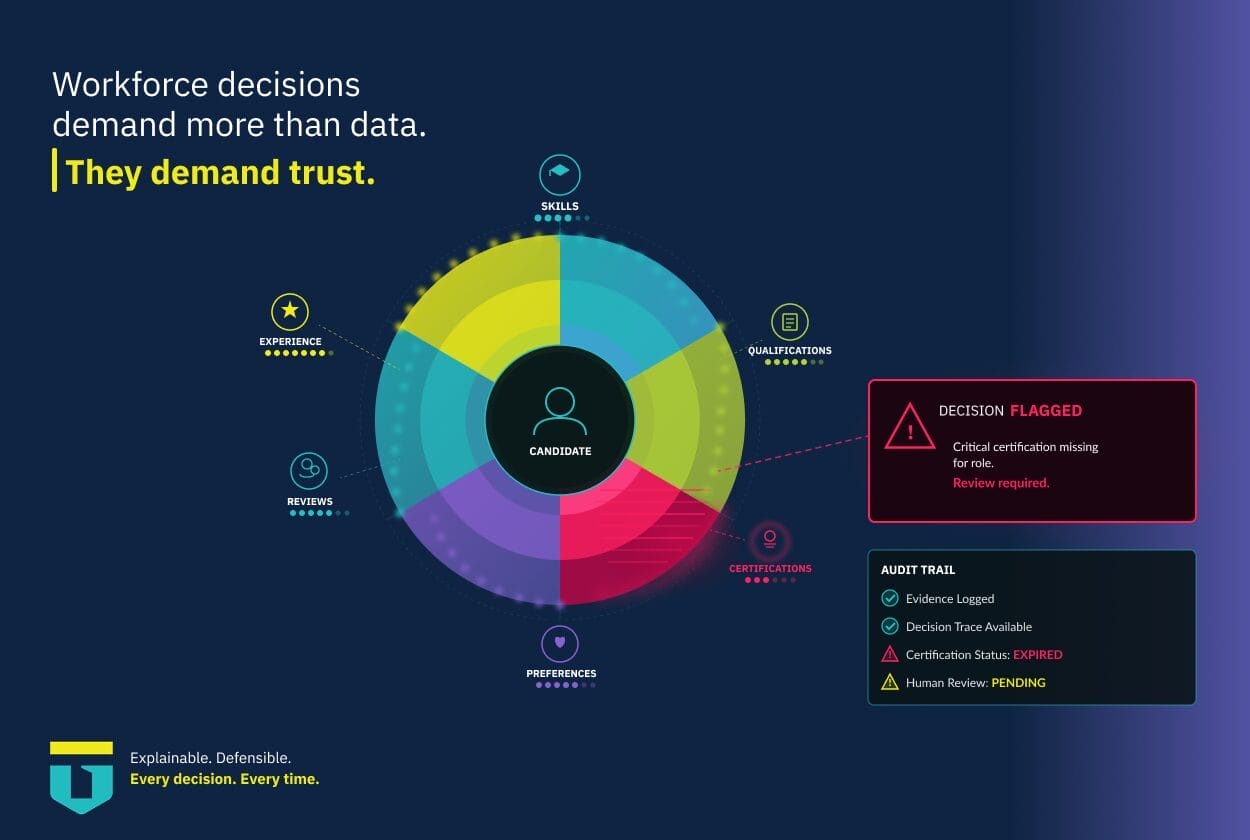
The HR technology industry has a contradiction it needs to answer for. These are the companies whose entire market value is built on helping other organizations attract, develop, and retain human talent. They sell workforce intelligence. They advise CHROs on engagement, retention, and the future of work. In the first quarter of 2026, they are […]