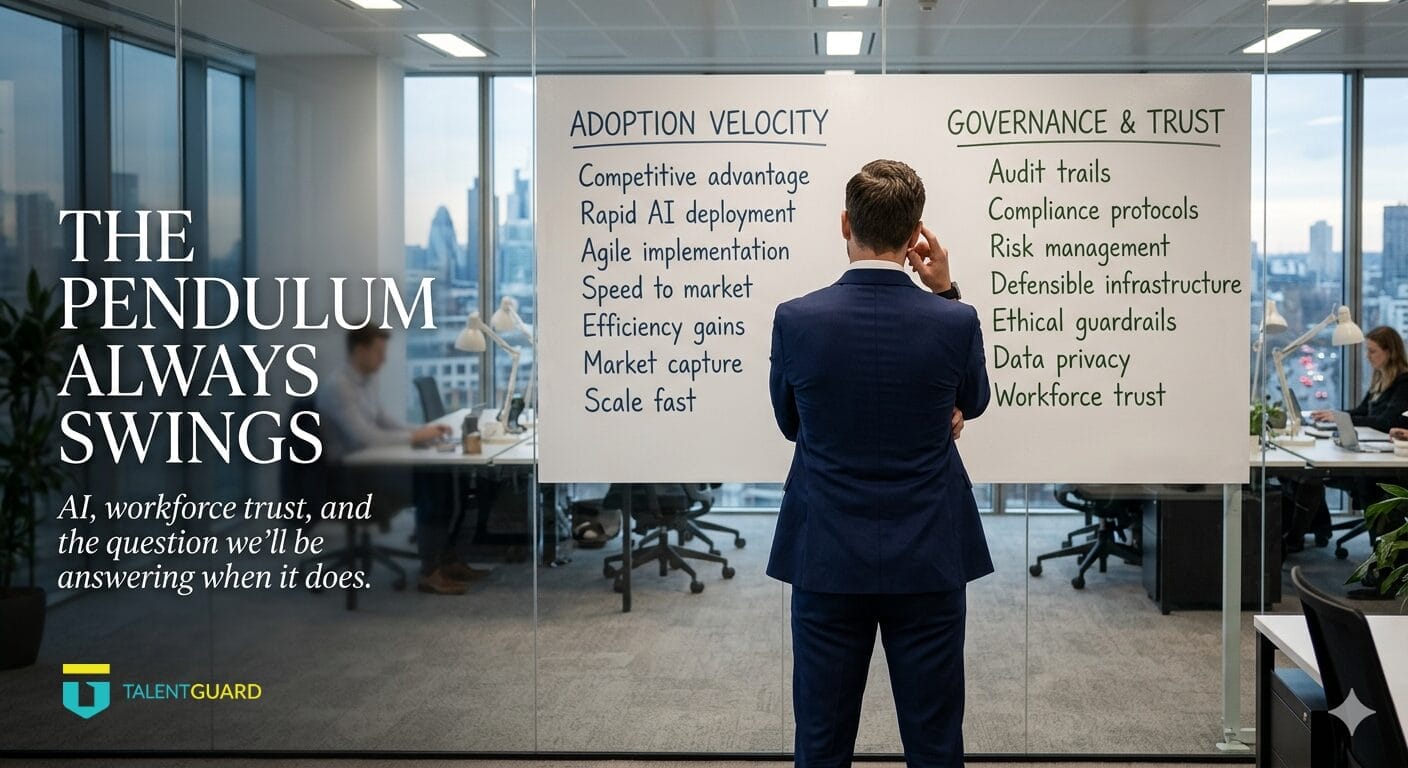
The Pendulum Always Swings, This Time It’s AI Governance
AI, workforce trust, and the question we’ll be answering when it does
We have been here before. Not with AI governance specifically, but with the particular combination of genuine capability, unchecked optimism, compressed timelines, and the human cost that follows when the accounting finally comes due. The steam engine displaced textile workers before labor law existed to absorb the shock. The assembly line created enormous productivity and then the Great Depression exposed what happens when purchasing power collapses faster than efficiency gains can replace it. ATMs were supposed to eliminate bank tellers; instead, the teller workforce grew for twenty years. Until it didn’t. Each time, the pattern holds: adoption accelerates ahead of governance, the early returns validate the optimists, and then something breaks in a way the dashboards never predicted.
The difference this time is the speed and the near-total absence of the infrastructure that has historically slowed the pendulum down.
The Data Is In, and It Is Not What the Slide Decks Promised
Fifty-five percent of employers now regret the AI-driven headcount cuts they made. Two-thirds are already rehiring. Nearly one-third spent more on that rehiring than they saved on the original cuts. Fortune and HR Executive documented these outcomes, with named companies and quantified costs.
Meanwhile, only 27% of workers fully trust their employers to use AI responsibly. Fifty-nine percent believe AI makes workplace bias worse. Eighty-three percent want to know what data an AI system used when it made a decision about them. AI adoption in HR climbed from 26% to 43% in a single year. Of those early adopters, the share of organizations with any AI policy in place: 49%.
Read those two sets of numbers together. Organizations are deploying AI at a rate that doubled in 12 months into a workforce that doesn’t trust the process, led by executives who are now, in documented numbers, regretting the pace, and roughly half of them are doing it without a governing framework. That is a pendulum at full extension.
This Is Not New. What Is New Is the Absence of Guardrails.
Every significant labor disruption in modern history eventually produced a countervailing structure. The Progressive Era brought labor law. The industrial age built unions. The outsourcing wave generated trade adjustment assistance. These structures were imperfect, often inadequate, frequently too slow. But they existed. They were the mechanisms by which society absorbed the velocity of change without the whole system breaking.
The AI disruption is moving faster than any of those precedents, and the countervailing structures aren’t keeping pace. Regulators are drafting frameworks as deployment accelerates past them. Internal governance policies are running 18 months behind adoption curves. Courts are making determinations about algorithmic discrimination using legal frameworks written for human decision-makers. The Colorado AI Act sets an enforcement date of June 30, 2026. The organizations that should have been building compliance infrastructure twelve months ago are reading about the deadline now.
The historical pattern isn’t that technology is bad, or that disruption is inherently harmful. The pattern is that moving faster than governance can absorb always produces a human cost. The only variable is who pays it, and how long the accounting takes to arrive.
The Agentic Announcement Is the Tell
Workday, Oracle, and SAP recently launched or expanded “agentic” AI capabilities. Josh Bersin published a major framework repositioning the entire HR tech market as moving from assistance to orchestration. These announcements landed in the same news cycle as documentation that 88% of HR leaders see no significant ROI from their current AI investments and that only 28% of AI projects deliver on their projected returns.
The market is accelerating into autonomous AI orchestration at the exact moment it has the least evidence that the previous generation of AI investment delivered what it promised. That is not a coincidence. That is how technology market cycles work. The announcement wave always outruns the evidence base.
History has seen this before. The dot-com era produced announcements about market disruption that proved mostly correct, just a decade later than the announcements implied, and after the original investors had been wiped out twice. The productivity boom from personal computing took 15 years longer to appear in GDP statistics than economists expected. Genuine capability and genuine accountability don’t run on the same timeline. Confusing them is expensive.
What Will We Look Like When It Swings Back?
The pendulum will swing back. It always does. The question isn’t whether the reckoning will come with the pace, the AI governance gap, the trust deficit. It will. The question is what organizations will look like when it arrives.
Some will be in litigation. The Mobley v. Workday case cleared a collective-action threshold that creates a federal template for class liability against AI hiring vendors. Organizations that cannot reconstruct a coherent audit trail of how an automated system made decisions about a protected class of workers will find themselves in a very uncomfortable discovery process.
Some will be in a rehiring scramble, paying premium rates to rebuild institutional knowledge they eliminated in a cost-reduction cycle that didn’t survive contact with actual operations.
Some, the ones who built AI governance infrastructure before regulation required it, who can explain to a regulator, a works council, or a plaintiff’s attorney exactly how a readiness assessment was built and who owned it, will be standing on solid ground.
The historical record on technology disruption doesn’t indict the technology or treat the disruption as avoidable. It shows that the organizations and institutions that survived the correction understood the difference between adoption and accountability and built for both.
We’re at the point in the cycle where that choice is still available. The pendulum is still moving outward. Every organization in this space must answer the same question: not whether it will come back, but what you will have built by the time it does.
Where TalentGuard Fits
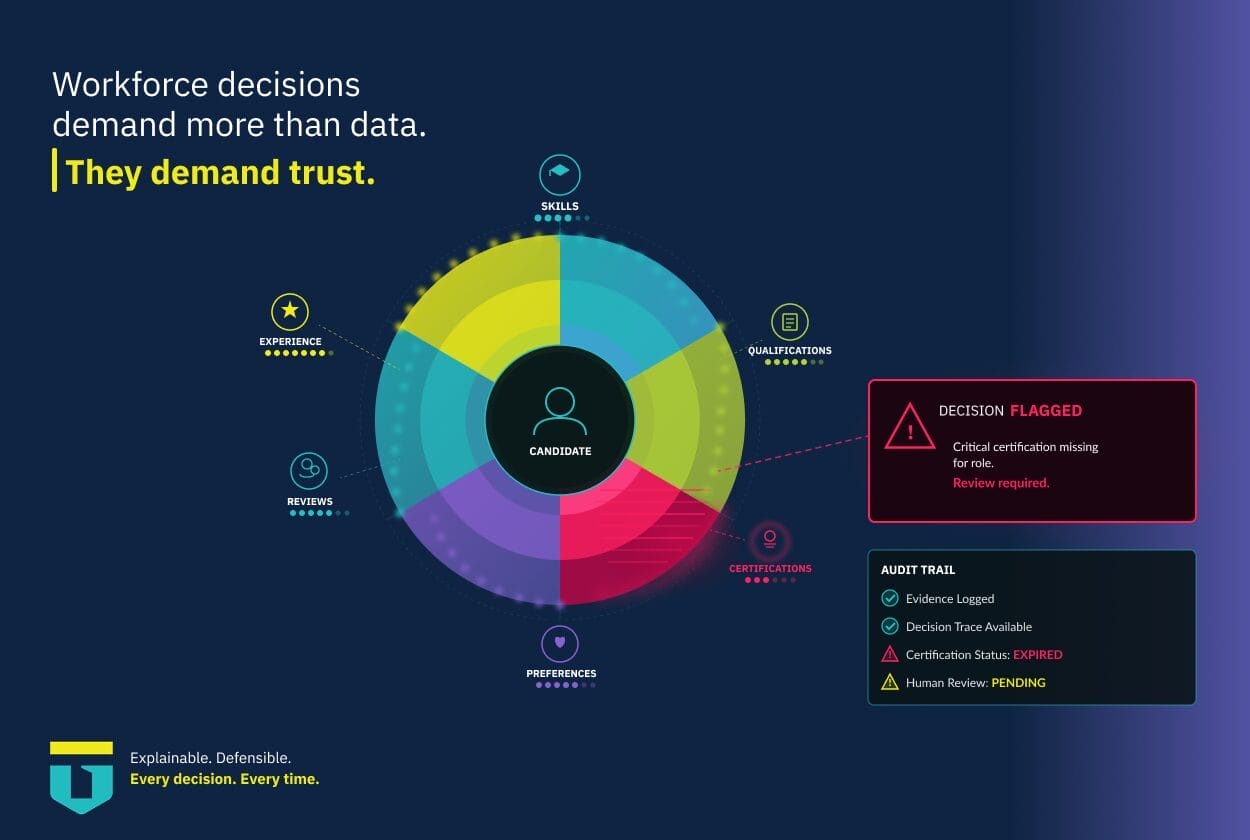
The AI workforce governance gap has a specific shape in workforce technology. Most enterprises have the data. What they’re missing is the infrastructure to make that data defensible: skills that are validated rather than self-reported, readiness assessments that are auditable rather than inferred, decision records that can be explained to the people they affect.
TalentGuard built Enterprise Skills Trust and Readiness Intelligence (ESTRI) for exactly that moment. Not a dashboard. Not a matching engine. Come see how we measure Trust, quantify Readiness and make all your personnel decisions Defensible.
Are you ready to see what AI Workforce Governance looks like in action?
Skills you can trust. Readiness you can defend.
FAQs
Is this a new problem, or has this pattern happened before with other technologies?
The pattern is familiar — the steam engine, the assembly line, and ATMs all followed the same arc of rapid adoption outrunning the safeguards meant to absorb its impact. What’s different this time is speed: AI deployment is accelerating faster than any prior disruption, while the countervailing structures that historically caught up — labor law, unions, trade adjustment assistance — haven’t kept pace. The technology itself isn’t the issue; moving faster than governance can absorb is what has historically produced a human cost, and that dynamic is repeating at a faster clip.
2. What’s the actual evidence that AI-driven workforce decisions are backfiring?
The numbers are concrete and documented rather than anecdotal. Fifty-five percent of employers now regret AI-driven headcount cuts, two-thirds are already rehiring, and nearly a third spent more on rehiring than they originally saved from the cuts. At the same time, adoption climbed from 26% to 43% of organizations in a single year, while only about half of those adopters have any AI governance policy in place. Read together, that’s rapid deployment outpacing the infrastructure meant to make it defensible.
3. Why does employee trust matter if the AI systems are technically working?
Because trust and technical function are separate questions, and only one of them is being measured. Only 27% of workers fully trust their employers to use AI responsibly, 59% believe AI makes workplace bias worse, and 83% want visibility into what data an AI system used to make a decision about them. A system can run exactly as designed and still erode the workforce’s confidence in it — and that erosion shows up as disengagement or attrition long before it shows up as a formal complaint.
4. What is the Mobley v. Workday case, and why does it matter for HR leaders?
It’s a case that cleared a collective-action threshold, which creates a federal template for class liability against AI hiring vendors. Practically, that means organizations that can’t reconstruct a clear audit trail of how an automated system made decisions about a protected class of workers face real exposure in discovery. It shifts algorithmic hiring decisions from a policy conversation into a documented legal liability.
5. What does it mean to build “AI governance infrastructure” in practice, and how is it different from having an AI policy?
A written AI policy states intent; governance infrastructure is what lets an organization actually produce evidence when asked. That means skills data that’s validated rather than self-reported, readiness assessments that are auditable rather than inferred, and decision records that can be explained to a regulator, a works council, or the employee affected. The distinction matters because roughly half of organizations already have some AI policy — but a policy alone doesn’t generate the documented trail that a court or regulator would actually accept as an answer.
See a preview of TalentGuard’s platform
Compliance Is a Design Document. Are You Reading It That Way?
Most HR leaders approach AI regulation the same way they approach a compliance audit: head down, running a checklist of things they’re not supposed to do. When a law drops with penalties attached, the first instinct is defensive. There’s a more useful way to read NYC Local Law 144, the EU AI Act, and the […]
When AI Gets HR Wrong: The Accountability Framework Every Talent Leader Needs
The HR technology industry has a contradiction it needs to answer for. These are the companies whose entire market value is built on helping other organizations attract, develop, and retain human talent. They sell workforce intelligence. They advise CHROs on engagement, retention, and the future of work. In the first quarter of 2026, they are […]
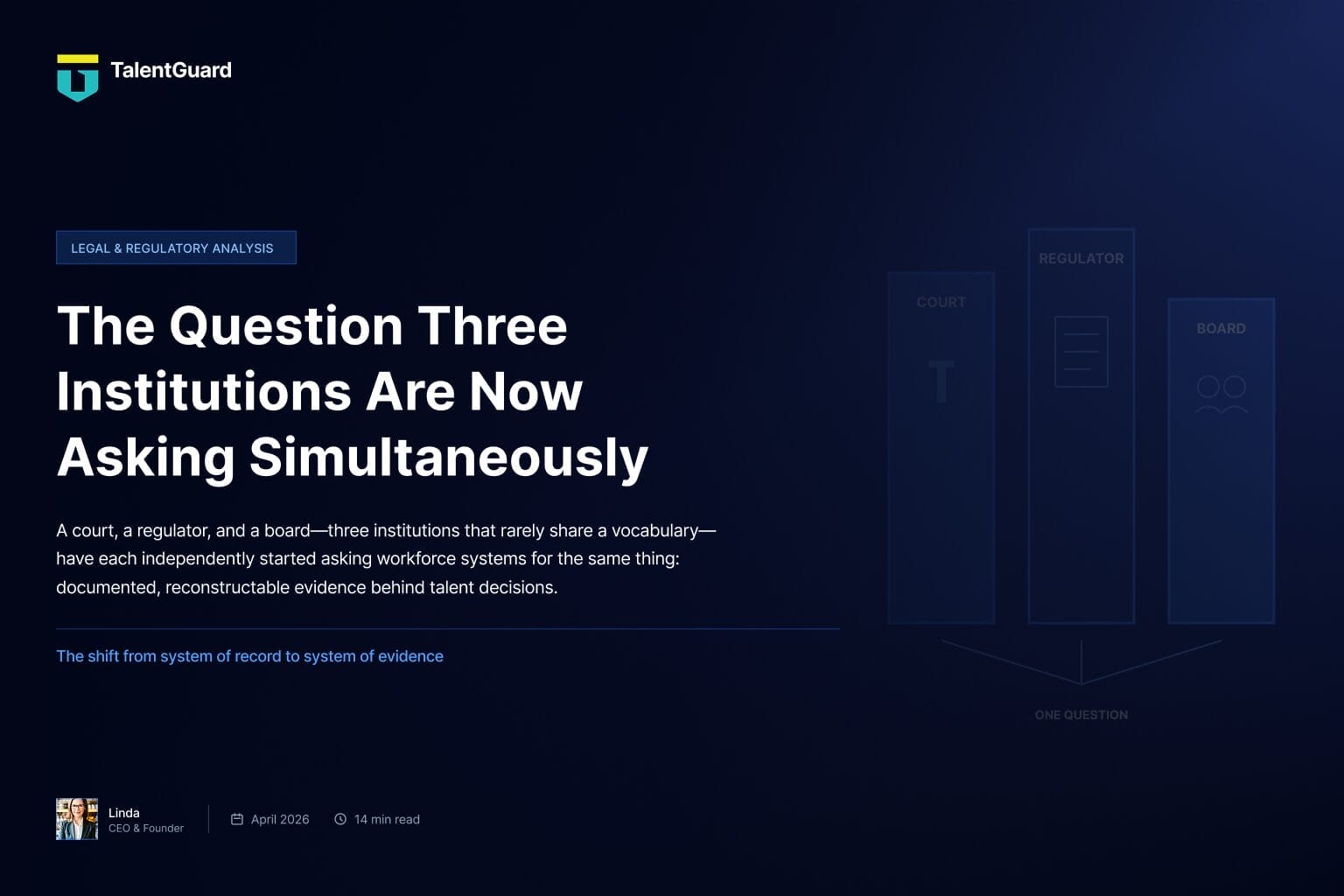
The New Workforce Intelligence Standard: What the Mobley Ruling, the EU AI Act, and Board Succession Reviews Now Require
Something quiet has happened in the last eighteen months, and most workforce intelligence leaders haven’t named it yet. A federal court, a regulatory body, and a corporate governance committee — three institutions that rarely share a vocabulary, much less a question — have each independently started asking workforce systems to produce the same thing. Not […]