The New Workforce Intelligence Standard: What the Mobley Ruling, the EU AI Act, and Board Succession Reviews Now Require
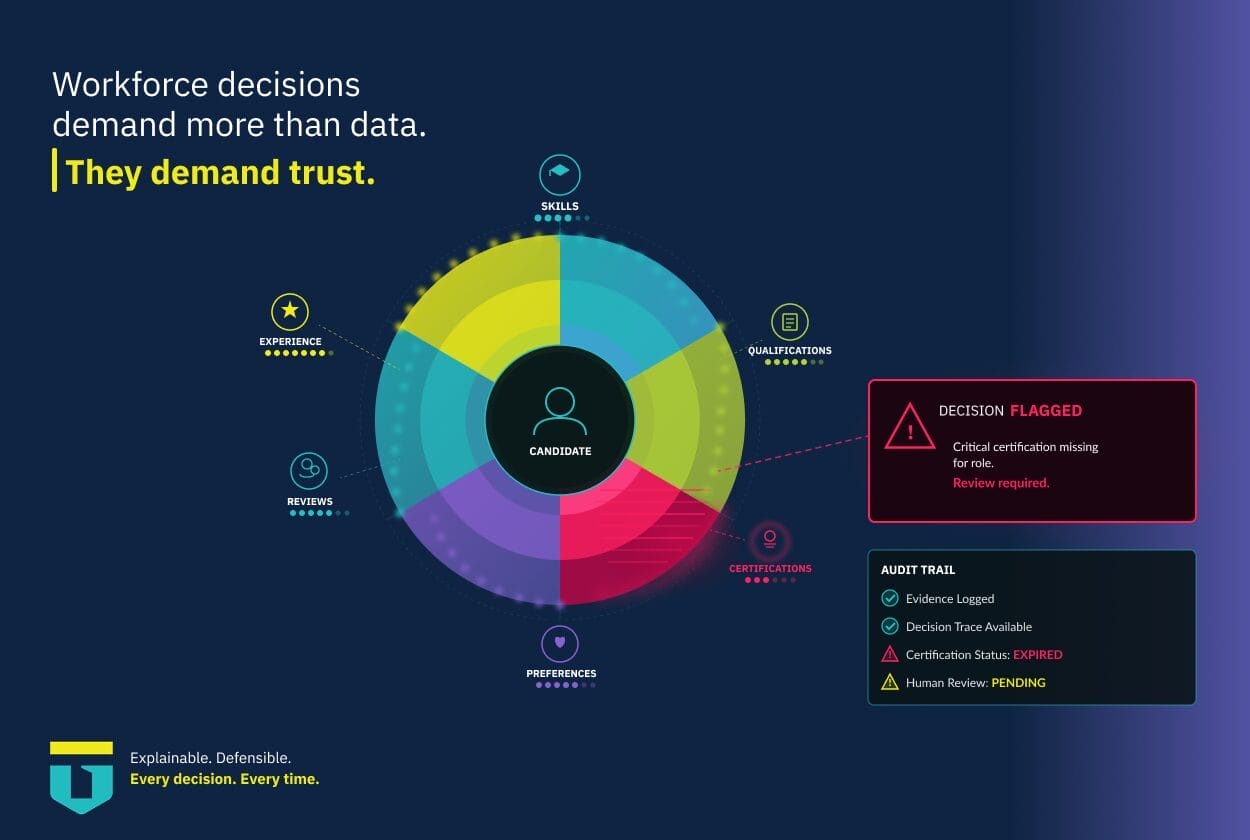
When AI Gets HR Wrong: The Accountability Framework Every Talent Leader Needs
The HR technology industry has a contradiction it needs to answer for.
These are the companies whose entire market value is built on helping other organizations attract, develop, and retain human talent. They sell workforce intelligence. They advise CHROs on engagement, retention, and the future of work. In the first quarter of 2026, they are laying off their own people and crediting artificial intelligence as the reason.
UKG cut 950 employees in April and cited “changes in technology driven by AI” as the rationale. That cut lands inside a broader pattern: across the tech sector in Q1 2026, more than 60% of announced layoffs explicitly named AI as a factor, up from 38% the prior year. That is not a company story. That is a market posture.
The irony would be easier to absorb if the technology performing those cuts were proven, audited, and accountable. It is not. And the question that posture raises — what happens when AI gets HR wrong? — is no longer abstract. It is a federal-court matter with named plaintiffs and a certified class.
HR leaders who have not yet built a formal AI governance framework are not operating in a gray zone. They are operating in a closing window.
The AI Tax Nobody Budgeted For
Before the legal cases, before the regulatory frameworks, the workforce itself named the problem.
Employees across industries are flagging a hidden cost in the hours spent checking, correcting, and explaining around required AI outputs. Exit interviews are surfacing it. Engagement surveys are capturing it. Workers have a name for it: the AI tax. The framing matters because it signals the beginning of a formal accountability chain.
The AI tax is entering manager vocabulary, which means it will start appearing in formal grievances and arbitration within 12 to 18 months. What began as hallway frustration is becoming documentation. And documentation becomes discovery.
Organizations that built their business case on gross AI productivity gains without measuring the drag on the other side of the ledger are sitting on an exposure they did not price in. Companies that staked internal and external credibility on AI productivity claims now face a workforce building an evidence-based counter-case. That counter-case is not theoretical. It is being filed in federal court.
The Legal Frame Has Changed
In May 2025, Mobley v. Workday cleared the collective-action threshold under the Age Discrimination in Employment Act. By March 2026, the case had survived a second motion to dismiss, with an amended complaint reasserting state-law and disability claims. That pattern of legal momentum signals the federal precedent is hardening, not retreating.
A federal court determined that a class of plaintiffs harmed by AI-driven hiring decisions has standing to pursue collective action against the platform that made those decisions. The harm alleged is not hypothetical disparate impact. It is discriminatory outcome, at scale, attributed to an automated system.
On the regulatory side, the Colorado AI Act remains on the books with a June 30, 2026 effective date, even as the state Attorney General has signaled enforcement will pause pending rulemaking. Meanwhile, the EU AI Act — which classifies AI systems used in HR and people analytics as high-risk — is taking full effect. Like GDPR before it, the EU AI Act applies extraterritorially. If your organization serves EU customers or handles EU citizen data, you are in scope regardless of where your headquarters is located. The US Senate’s draft SAFE Innovation Framework echoes many of the same risk principles.
The regulatory direction is clear. Governance frameworks for high-risk AI in employment decisions are moving from theoretical to operational. The window to build before it is required is closing.
The Question the Industry Has Avoided
What happens when AI gets it wrong? Not in the abstract. Specifically: who is accountable when an AI-assisted hiring decision screens out a qualified candidate based on a protected characteristic? Who owns the outcome when an AI performance management tool flags an employee for review based on inputs the employee never saw and cannot contest? Who explains the decision when there is no human in the loop?
The dominant industry posture has been to defer these questions. That posture is becoming a liability.
The organizations that come through this transition with their credibility intact will answer these questions before a courtroom or a congressional hearing forces them to. They will publish an accountability framework before regulators require one. They will disclose how bias audits work, who reviews automated decisions, and what the appeals process looks like for someone who believes a machine got them wrong.
The accountability gap has a shape. It maps almost exactly to what happens when organizations treat skills data as a reporting problem rather than a decision infrastructure problem. Skills are self-reported or inconsistently validated. Job profiles drift by manager and region. Learning activity disconnects from role requirements. When someone challenges a decision, internally or in a courtroom, the organization cannot reconstruct a coherent story: what evidence led to what outcome?
That is not an AI problem. That is a governance hole that AI tears wider.
Why HR AI Is Classified as High-Risk
The EU AI Act’s high-risk classification for HR AI is not arbitrary. HR touches the most sensitive parts of people’s working lives, and the failure modes are consequential:
- Opaque skills scoring can unfairly influence promotion decisions
- Bias in role profile generation can reinforce gender or racial disparities at scale
- Poor audit trails produce compliance failures and failed regulatory reviews
- Automated decisions without human oversight remove the recourse employees are entitled to
Under the EU AI Act, high-risk systems must meet strict obligations for transparency, traceability, human oversight, and bias monitoring. This includes maintaining detailed documentation, enabling independent audits, and involving subject-matter experts in every consequential step of the workflow. Generic claims about “responsible AI” do not satisfy these requirements. Specific, documented, testable processes do.
The 4-Checkpoint AI Governance Framework for HR
At TalentGuard, we built a human-in-the-loop governance model explicitly designed for HR’s specific risk profile. The framework addresses the accountability gap at the point where it most commonly opens: in the data, in the validation process, in the bias testing, and in the audit trail.
Checkpoint 1: Data Provenance and Grounding
AI models are only as trustworthy as the data they are built on. General-purpose AI draws on scraped web data and crowd-sourced labels — sources that carry unknown bias, variable quality, and no organizational context. That is not an acceptable foundation for decisions that affect people’s careers.
WorkforceGPT grounds every output in authoritative corpora: our licensed, continuously updated version of the IBM Talent Frameworks, which we have expanded over five years, combined with customer-specific job data validated by internal stakeholders. We use GraphRAG — an advanced retrieval-augmented generation architecture — to ensure every model output contextually aligns with each client’s unique workforce structure.
This approach mitigates hallucination and keeps the AI anchored to structured, verified data rather than probabilistic inference from unvetted sources. The provenance question — where did this output come from? — has a specific, documentable answer for every WorkforceGPT output.
What to ask your vendor: Can you trace model outputs to vetted, structured data sources? Do you use retrieval-augmented generation, and if so, how is it customized to each client’s organizational context?
Checkpoint 2: SME Validation Loop
Every role profile and development plan generated by WorkforceGPT passes through two layers of human oversight before it enters production: an HR Business Partner or Talent Development lead, and a Business Line Subject Matter Expert.
These reviewers can redline AI suggestions, adjust role definitions, and reframe competency language. WorkforceGPT’s change-tracking mode logs every modification, making it easy to audit not just what the final output was, but what the AI originally suggested and what human judgment changed.
We call this the Red Team, Blue Team model for HR — aligning technology with expertise rather than substituting one for the other. The human remains the decision-maker. The AI provides the structured starting point that human judgment refines and validates.
What to ask your vendor: Who reviews and validates generated role profiles or skill maps? Is SME input a required step in your workflow, or an optional feature? What is logged from the validation process?
Checkpoint 3: Bias and Hallucination Testing
Bias does not only appear in outputs. It hides in edge cases, in underrepresented demographic cohorts, and in the gap between how a system performs in a controlled test and how it performs on real-world data. Testing only for visible outputs misses most of the risk.
TalentGuard embeds automated fairness tests at multiple stages of the WorkforceGPT pipeline:
- Gendered-language scanning for job descriptions and role profiles
- Disparate impact simulations across demographic cohorts
- Model regression testing triggered after every fine-tuning cycle
Every update to the WorkforceGPT engine is reviewed against our benchmark set to catch statistical drift or unintended behavioral changes. If outputs skew, we roll back and retrain. The testing is not a one-time gate at deployment. It is a continuous process embedded in our MLOps pipeline.
What to ask your vendor: How do you test for bias — specifically? Are disparate impact simulations and demographic cohort testing part of your standard process? What triggers a rollback?
Checkpoint 4: Audit Trail and Rollback
Compliance does not stop at sign-off. It requires a continuous record that survives a regulatory inquiry, a legal challenge, or an employee dispute months or years after the original decision was made.
TalentGuard’s platform creates a cryptographically timestamped record of every AI-generated role profile, skill assessment, and recommendation. Each item is version-controlled and fully auditable, with:
- Immutable JSON logs of what was generated and why
- User interaction history across HR, managers, and employees
- A 30-day rollback protocol in case of error or dispute
This is not built for EU audits alone. Trust is earned with traceability. When an employee asks why they were assessed a certain way, when a regulator asks what data informed a decision, or when legal counsel needs to reconstruct a decision chain, the answer is in the log.
What to ask your vendor: Can you provide an immutable audit trail for every AI-generated recommendation? What is your rollback mechanism, and how quickly can you revert a problematic output?
AI Governance in HR: A Risk and Readiness Matrix
| Governance Dimension | Unaddressed Risk | Checkpoint | TalentGuard’s Approach |
|---|---|---|---|
| Data quality and provenance | Hallucination, unverifiable outputs | Checkpoint 1 | GraphRAG grounded in licensed IBM Talent Frameworks and client-validated data |
| Human oversight | Automated decisions with no review or recourse | Checkpoint 2 | Required SME validation loop with logged change tracking |
| Bias in outputs | Discriminatory outcomes at scale | Checkpoint 3 | Gendered language scanning, disparate impact simulation, regression testing after every update |
| Audit and traceability | Cannot reconstruct or defend decisions | Checkpoint 4 | Cryptographic timestamps, immutable JSON logs, 30-day rollback |
| Regulatory compliance | EU AI Act, ADEA, Colorado AI Act exposure | All four | Human-in-the-loop architecture designed for high-risk AI classification |
| Employee recourse | No mechanism to contest AI-informed decisions | Checkpoints 2 and 4 | Validation logs and audit trail support formal review and appeals |
7 Questions to Ask Any AI HR Vendor
Generic assurances about responsible AI are not a governance framework. When evaluating any HR platform that uses AI, ask for specifics.
- What is your data provenance? Can you trace model outputs to vetted, structured data sources, and can you show us which sources?
- Do you use retrieval-augmented generation? If so, how is it customized to our organizational context, and what prevents the model from hallucinating outside that context?
- Who reviews AI-generated outputs? Is SME validation a required step in your workflow, and what is logged from that process?
- How do you test for bias? Are disparate impact simulations and demographic regression tests part of your standard MLOps pipeline, or are they available as an add-on?
- What does your audit trail contain? Can you show us what is logged for every role change or development recommendation, and how long that log is retained?
- What is your rollback mechanism? How quickly can you revert a problematic output, and what triggers that process?
- How are you preparing for EU AI Act and ADEA compliance? What specific documentation, policies, and testing protocols can you share?
If a vendor responds to these questions with marketing language rather than process documentation, that response is itself meaningful information.
Read More
- The ESTRI Framework: A Buyer’s Guide to Enterprise Skills Trust and Readiness Intelligence
- AI Alignment Is Not a Technical Problem: It Is a Workforce Readiness Crisis
- The Complete AI HR Software Buyer’s Guide
- TalentGuard vs. Legacy Talent Management: An AI Comparison
- The New Workforce Intelligence Standard: What the Mobley Ruling, the EU AI Act, and Board Succession Reviews Now Require
- Request a TalentGuard Demo
About TalentGuard
TalentGuard powers Enterprise Skills Trust and Readiness Intelligence so organizations can make talent decisions that are consistent, scalable, and defensible. We turn fragmented skills signals into a governed Skills Truth foundation: role-based standards, proficiency expectations, evidence and provenance, and a complete change history. On top of that foundation, TalentGuard delivers explainable role readiness and gap insights, then connects action loops across development, mobility, performance, succession, and certifications to measurable progress. The result is a trusted system of record for role and skills data that supports audit-ready reporting, stronger workforce planning, and better outcomes across the talent lifecycle.
Request a demo to see how TalentGuard helps you establish Skills Truth and operationalize readiness intelligence across your enterprise.
FAQs
What makes HR AI high-risk under the EU AI Act?
The EU AI Act classifies AI systems used in employment contexts as high-risk because the decisions they inform — hiring, performance evaluation, promotion, termination — significantly affect individuals’ access to employment and economic opportunity. High-risk systems face mandatory requirements for transparency, human oversight, bias monitoring, detailed documentation, and the ability to support independent audits. These requirements apply to any organization that serves EU customers or handles EU citizen data, regardless of where the organization is headquartered.
What is Mobley v. Workday and why does it matter for HR leaders?
Mobley v. Workday is a federal class action filed under the Age Discrimination in Employment Act. The case alleges that Workday’s AI-driven hiring tools produced discriminatory screening outcomes. In May 2025, the case cleared the collective-action threshold, and by March 2026 it had survived a second motion to dismiss. The significance for HR leaders is that a federal court determined a class of plaintiffs harmed by AI-driven hiring decisions has standing to sue the platform that made those decisions. This is the first major federal case to establish that accountability for AI-driven hiring bias can be litigated at scale. Every HR technology vendor and every employer using AI in hiring should be watching this case.
What is the AI tax and why is it a governance signal?
The AI tax refers to the hidden hours employees spend checking, correcting, and explaining around AI outputs they are required to use. It is a governance signal because it represents the gap between the productivity gains AI vendors report and the actual productivity employees experience. More importantly, it signals the beginning of a formal accountability chain: the frustration being expressed informally today tends to appear in formal grievances, arbitration, and legal proceedings within 12 to 18 months. Organizations that measure gross AI productivity without measuring the AI tax are building a credibility gap that may become a legal exposure.
Does the EU AI Act apply to US companies?
Yes, in the same way GDPR applies to US companies. If your organization serves EU customers, handles EU citizen data, or operates in EU markets, the EU AI Act applies to your AI systems that fall into high-risk categories. HR AI systems used for hiring, performance management, promotion, or termination decisions fall into the high-risk category. US companies that assumed GDPR compliance was sufficient will need to evaluate their HR AI systems against EU AI Act requirements, which are more specific about AI system documentation, human oversight, and bias monitoring.
What does “human-in-the-loop” mean in practice for HR AI?
Human-in-the-loop means that a human reviews and approves AI-generated outputs before those outputs affect a decision. In a governed HR AI system, this means role profiles generated by AI pass through HR Business Partner and SME review before publication. Readiness assessments surface to HR for review before informing succession or mobility decisions. Automated recommendations connect to a human approval step rather than executing directly. Human-in-the-loop is not a configuration option in a well-governed HR AI system. It is a required architectural feature.
How does the 4-checkpoint framework connect to TalentGuard’s ESTRI approach?
The 4-checkpoint framework is the safety architecture that ensures WorkforceGPT outputs are trustworthy. ESTRI — Enterprise Skills Trust and Readiness Intelligence — is the decision infrastructure that those outputs feed into. The checkpoints ensure the data is provenance-grounded, human-validated, bias-tested, and auditable. ESTRI ensures that data connects to role standards, readiness assessments, and action loops that organizations can act on and defend. Together they address the full accountability chain: trustworthy inputs, governed processing, explainable outputs, and an audit trail that survives scrutiny.
What should HR leaders do right now if they do not have an AI governance framework?
Start with the seven vendor questions above. Apply them to every AI-powered HR tool currently in use, not just tools you are evaluating. Inventory where AI-generated outputs affect employment decisions without mandatory human review, and close those gaps. Document your current bias testing practices — if the documentation does not exist, the practices are insufficient for regulatory purposes. Assign named accountability for AI governance: someone in your organization needs to own the answer to “what happens when AI gets it wrong?” before that question arrives in a formal complaint.
The Standard Worth Meeting
The workers losing their jobs to fund AI investments, the employees logging invisible hours auditing outputs they did not ask for, and the plaintiffs asking a federal court to hold an algorithm accountable are all making the same basic claim: the humans in this equation still matter.
The HR technology industry built its market position on the premise that it understood the human side of technology better than anyone else. That argument now requires proof — not in the form of mission statements, but in the form of documented processes, auditable decisions, and governance infrastructure that organizations can stand behind when it is tested.
The question is not whether AI governance in HR will be required. It will be. The question is whether your organization builds the framework now, on your terms, or builds it in response to a regulatory inquiry, a legal filing, or an employee dispute.
The window to choose is open. It is not open indefinitely.
See a preview of TalentGuard’s platform
The New Workforce Intelligence Standard: What the Mobley Ruling, the EU AI Act, and Board Succession Reviews Now Require
Something quiet has happened in the last eighteen months, and most workforce intelligence leaders haven’t named it yet. A federal court, a regulatory body, and a corporate governance committee — three institutions that rarely share a vocabulary, much less a question — have each independently started asking workforce systems to produce the same thing. Not […]
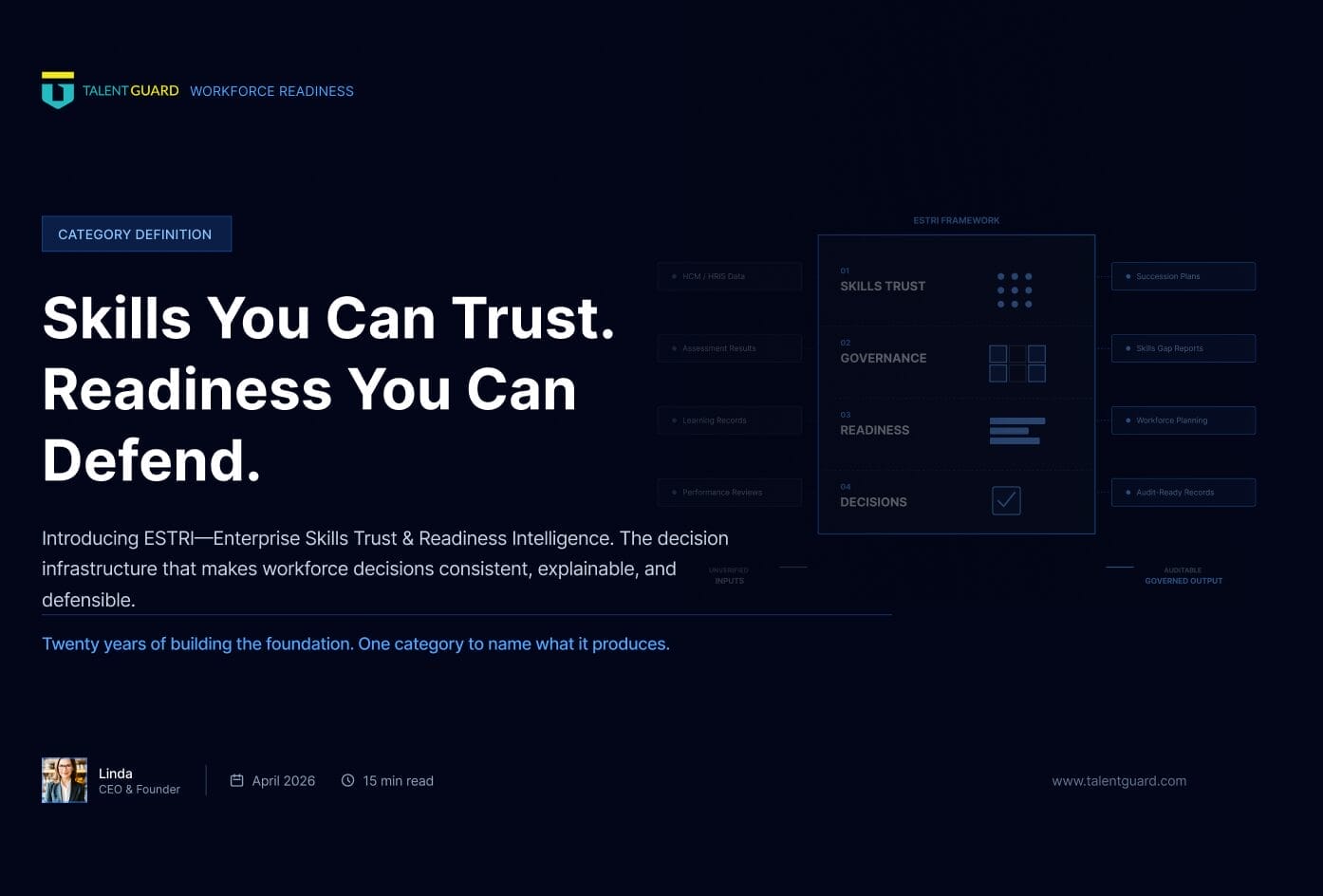
Skills You Can Trust. Readiness You Can Defend. Introducing ESTRI.
Twenty years of building the foundation. One category to name what it produces. CORE INSIGHT The gap was not visibility. Every organization had dashboards. The gap was trust. In my last post, I shared the story of how TalentGuard got here. The checkbox era. The career ladder with no data behind it. The deployments that […]
The Confidence that Precedes the Hardest Lessons
We went underground. We stayed there until we got it right. On twenty years of building the infrastructure the workforce actually needs and what the hardest lessons taught us about what it means to finish. There is a particular kind of confidence that precedes the hardest lessons. Not arrogance. Not carelessness. Just the reasonable certainty […]