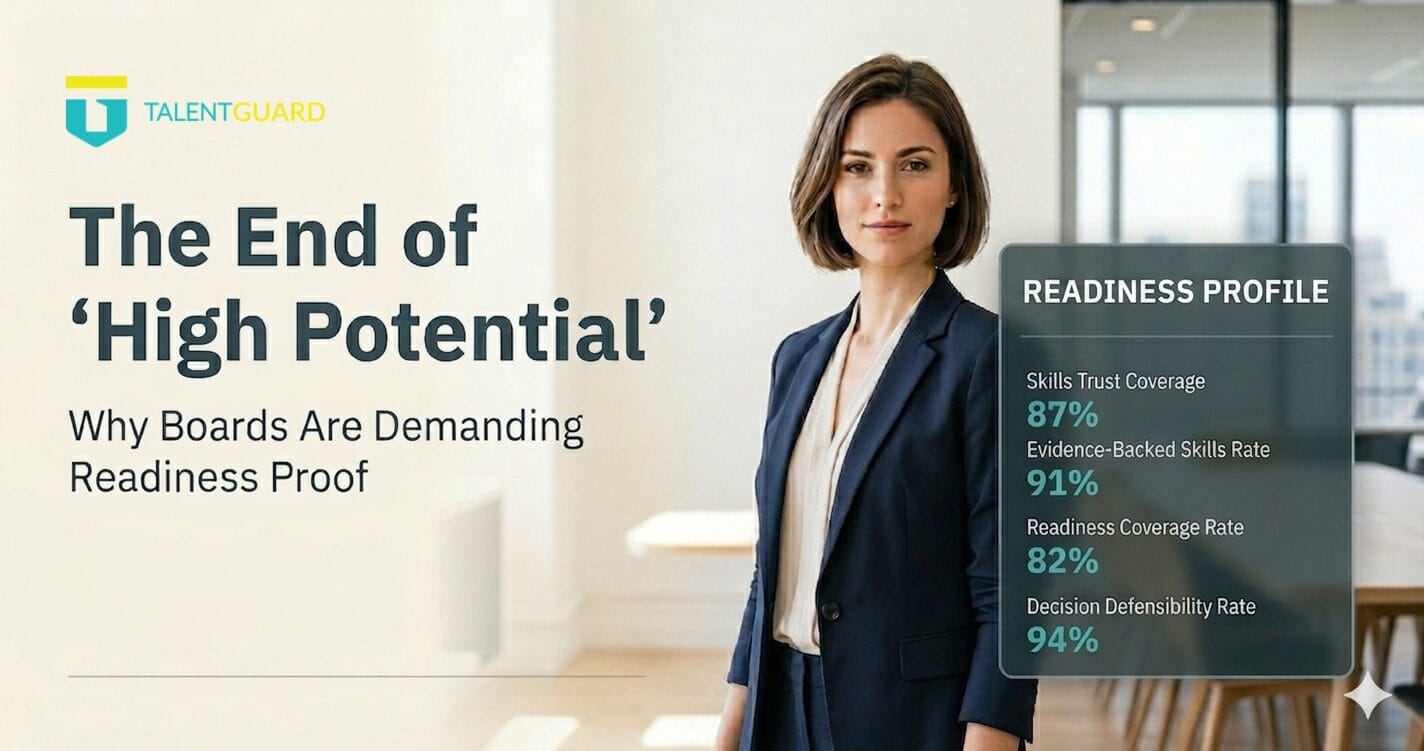
The End of “High Potential”: Why Boards Are Demanding Readiness Proof
For decades, succession planning lived in the comfortable ambiguity of potential, with little real visibility into succession planning readiness. Boards would convene, HR would present a slate, and somewhere in the conversation, a similar phrasing would emerge: she has what it takes. He’s a natural leader. Give it two years. That era is ending. New research from talent assessment firm Pinsight, released this month, signals a fundamental shift in how organizations build and validate their leadership pipelines. The question boards now ask is not who could lead, but rather who can perform now, in this role, under these conditions. The language has changed, and the evidentiary standard has shifted with it.
From Potential to Readiness Proof
The concept of “high potential” was always a proxy. Organizations used it because the alternative, actually measuring readiness against specific role requirements, was hard. It required assessments, structured data, and a willingness to make the invisible visible. It was easier to trust a manager’s gut read on a promising director than to build the infrastructure to validate it. What’s changed is the cost of being wrong.
Leadership failure at the Director and VP levels is no longer an abstract HR risk. Failure at this level is an operational event with immediate, visible consequences resulting in missed targets, team attrition, stalled initiatives, and board-level exposure. Pinsight’s 2026 research finds that boards increasingly treat Director and VP succession as a strategic risk management function, not a talent development exercise. The calculus has shifted. The downside of an unvalidated succession decision now outweighs the discomfort of building a more rigorous process. Readiness validation means mapping successors against specific competency requirements for specific roles. It means assessing not just skills but decision-making patterns, leadership style under pressure, and the capacity to operate in an environment that looks different from the one where their potential was first identified. It means generating evidence, not just anecdote.
The Bench Strength Problem
The readiness validation shift exposes a structural problem most organizations have avoided confronting: bench strength is not a snapshot. It is a condition. Most succession plans center on the singular question of who replaces the incumbent? That framing is understandable but incomplete. An organization with one strong successor at the VP level and no one behind them does not have a succession plan. It has a backup plan. When that person leaves, accepts a counteroffer, or moves to a competitor, the organization returns to zero.
Bench strength intelligence reframes the question. Instead of asking who is next, it asks: how deep is the pipeline at every critical tier, how ready are those people right now, and where are the gaps that represent genuine organizational risk? The difference is the difference between a photograph and a map. Board data reinforces the urgency. CEO succession currently ranks as the number one board practice identified as needing improvement. Only 8% of small business owners describe themselves as fully prepared for a leadership transition. Sixty-one percent of business owners prioritize finding the right next leader over extracting maximum value from a sale. That’s a signal that succession is increasingly understood as a stewardship question, not merely a financial one. These are not abstract statistics. They represent organizations that have accepted succession risk as a permanent feature of their operating environment.
The Director Gap Is the Real Story
Much of the public conversation about succession focuses on the top of the house, encompassing CEO transitions, board composition, and C-suite depth. That focus is warranted, but it obscures where the operational risk pools are and becomes more concentrated. The Pinsight research identifies a specific pressure point at the Director and VP levels that deserves more attention. These roles sit at the intersection of strategy and execution. They translate organizational direction into team-level action. When they fail, or when organizations fill them with leaders who are not actually ready, the effects cascade immediately in ways that a poorly prepared senior vice president, operating with more insulation and support, might not produce.
The Director Gap is real and understated. Organizations that have invested in CEO succession infrastructure have often underinvested in the tier below. That is where bench strength intelligence matters most. It’s often overlooked because it isn’t glamorous, and because it is where readiness gaps are most likely to stay invisible until they become too expensive to ignore.
What Succession Planning Readiness Requires
Building a readiness validation capability is not a software purchase. It is an organizational commitment to making talent decisions the same way rigorous organizations make other consequential decisions, with clear, structured data and an honest assessment of where the gaps are. That means:
- defining what readiness looks like for each critical role before a succession event occurs.
- assessing successors against those criteria on a regular cadence, not just when a departure is imminent.
- building the habit of updating the map — because a successor who was 70% ready 18 months ago may be fully ready today, or may have stalled, or may have developed a capability gap that was not visible when the last assessment ran.
It also means being honest about what the bench realistically looks like. Organizations that describe themselves as having a strong succession plan without being able to answer specific questions about successor readiness at multiple levels aren’t describing a plan, just an intention, an aspiration to readiness.
The Platform Dimension
TalentGuard built its succession solution on the premise that bench strength intelligence requires more than good intentions and periodic talent reviews. It requires a system that maps role-specific competency requirements, tracks successor development over time, surfaces readiness gaps before they become vacancies, and gives leaders and boards the visibility they need to make decisions with confidence rather than hope. The shift from potential to readiness validation is a correction, not a trend. Organizations that build the infrastructure to support that correction now will find themselves with a genuine competitive advantage when leadership transitions occur, not because they got lucky, but because they prepared. Are you ready?
About TalentGuard
TalentGuard powers Enterprise Skill Trust & Readiness Intelligence—so organizations can make talent decisions that are consistent, scalable, and defensible. We turn fragmented skills signals into a governed foundation: role-based standards, proficiency expectations, evidence and provenance, and a complete change history. On top of that foundation, TalentGuard delivers explainable role readiness and gap insights—then connects action loops (development, mobility, performance, succession, and certifications) to measurable progress. The result: a trusted system of record for role and skills data that supports audit-ready reporting, stronger workforce planning, and better outcomes across the talent lifecycle. Request a demo to see how TalentGuard helps you establish Skill Trust and operationalize readiness intelligence across your enterprise.
FAQs
What’s the difference between “high potential” and “readiness validation” in succession planning?
“High potential” was always a proxy — a manager’s gut read on someone promising, used because actually measuring readiness against role requirements was hard. Readiness validation replaces that anecdote with evidence: mapping successors against specific competency requirements for a specific role, and assessing decision-making patterns and leadership style under pressure, not just skills. The shift happened because the cost of being wrong about a leadership hire has become too high to keep relying on a gut read.
Why is bench strength different from having a single named successor?
Having one strong successor identified for a role isn’t a succession plan — it’s a backup plan. If that person leaves, takes a counteroffer, or moves to a competitor, the organization is back to zero. Bench strength intelligence asks a broader question: how deep is the pipeline at every critical tier, how ready is each person right now, and where are the gaps. It’s the difference between a single photograph and an ongoing map that gets updated as people develop or stall.
Why does the blog post focus on Director and VP-level succession instead of the C-suite?
Because that’s where the real operational risk concentrates, even though CEO transitions get most of the public attention. Director and VP roles sit at the intersection of strategy and execution — they translate direction into team-level action, so when someone unready fills that seat, the effects cascade immediately: missed targets, team attrition, stalled initiatives. Senior executives often have more insulation and support to absorb a readiness gap; a Director or VP typically doesn’t, which is why this tier deserves more scrutiny than it usually gets.
How often should successor readiness actually be assessed?
On a regular cadence, not just when a departure is imminent or a review cycle happens to fall due. A successor who was 70% ready 18 months ago may be fully ready today, may have stalled, or may have developed a gap that wasn’t visible at the last assessment. Treating readiness as a static, one-time judgment is exactly the practice this shift is moving away from — the map has to be kept current, not just built once.
Is having a documented succession plan the same as being ready for a leadership transition?
Not if that plan can’t answer specific questions about successor readiness at multiple levels. An organization that describes itself as having a strong succession plan but can’t point to structured readiness data for named tiers is describing an intention or an aspiration, not a validated plan. Genuine readiness means being able to show, with evidence, where each successor stands against defined role requirements — not just naming who’s “next in line.”
See a preview of TalentGuard’s platform
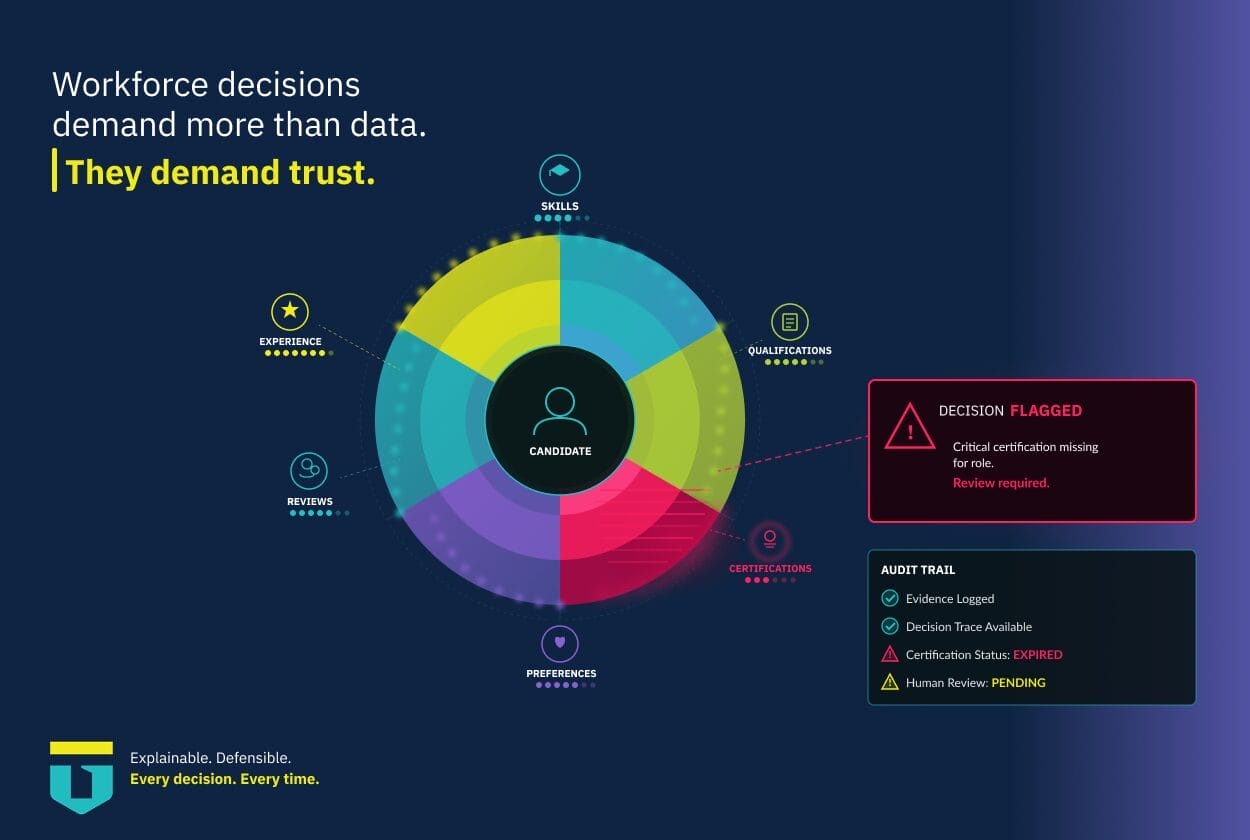
When AI Gets HR Wrong: The Accountability Framework Every Talent Leader Needs
The HR technology industry has a contradiction it needs to answer for. These are the companies whose entire market value is built on helping other organizations attract, develop, and retain human talent. They sell workforce intelligence. They advise CHROs on engagement, retention, and the future of work. In the first quarter of 2026, they are […]
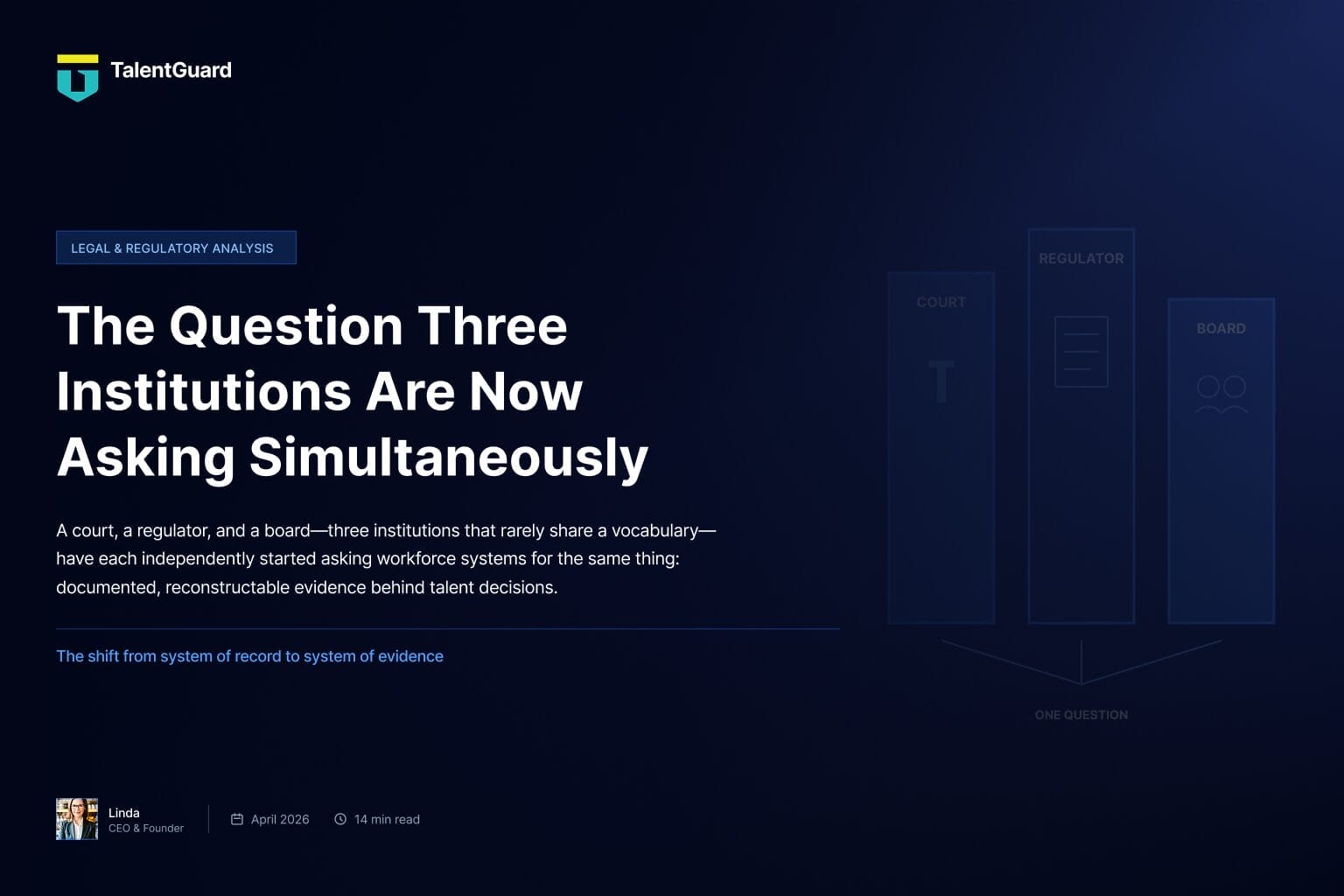
The New Workforce Intelligence Standard: What the Mobley Ruling, the EU AI Act, and Board Succession Reviews Now Require
Something quiet has happened in the last eighteen months, and most workforce intelligence leaders haven’t named it yet. A federal court, a regulatory body, and a corporate governance committee — three institutions that rarely share a vocabulary, much less a question — have each independently started asking workforce systems to produce the same thing. Not […]
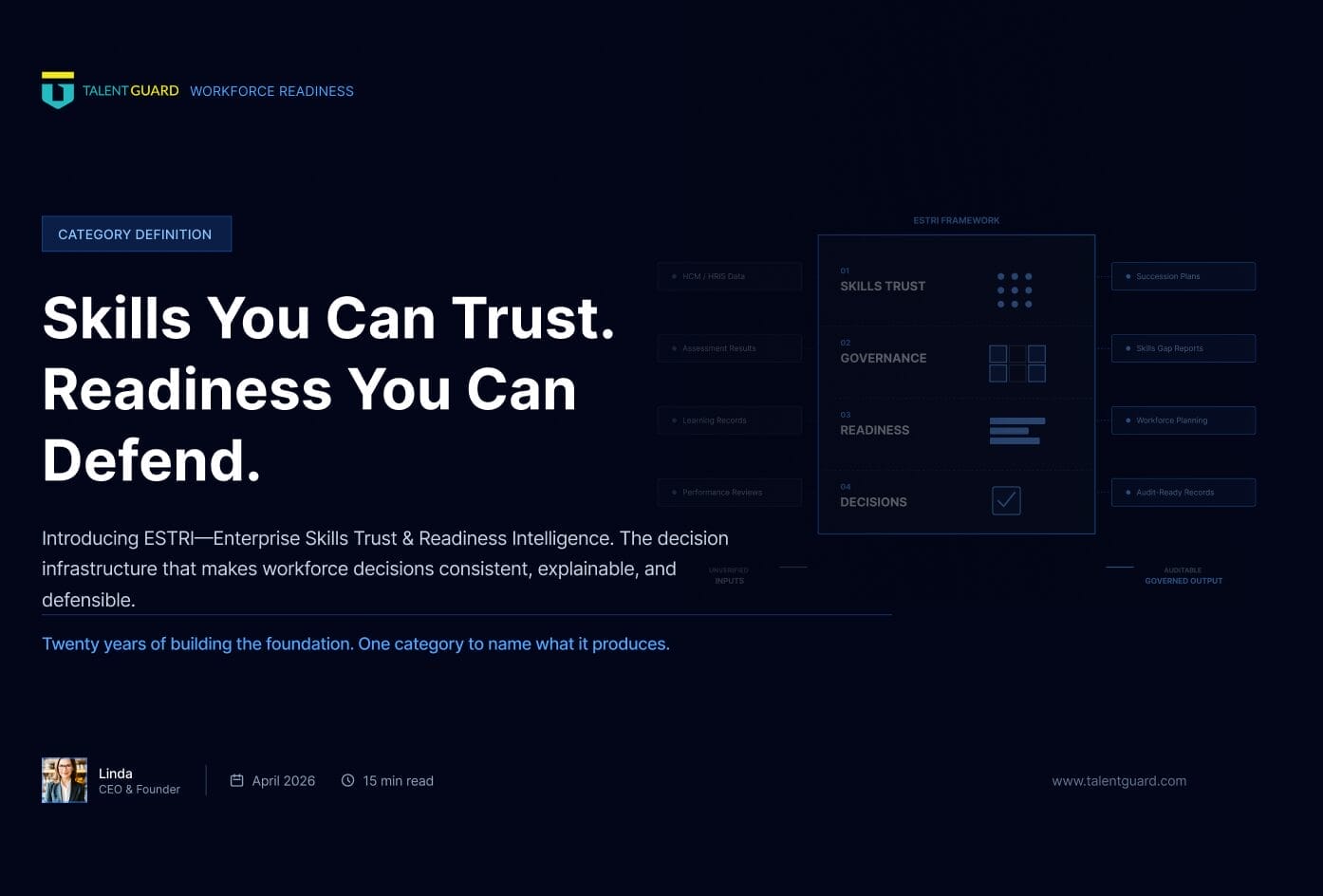
Skills You Can Trust. Readiness You Can Defend. Introducing ESTRI.
Twenty years of building the foundation. One category to name what it produces. CORE INSIGHT The gap was not visibility. Every organization had dashboards. The gap was trust. In my last post, I shared the story of how TalentGuard got here. The checkbox era. The career ladder with no data behind it. The deployments that […]