Successful Skill Development Examples for Employee
Whether your company is grappling with talent management for the first time, looking to modernize outdated tools, or searching for that extra competitive edge, here are examples to meet you where you are.
Facing rapid technological changes, launch a “Future Ready” program and provide employees with resources to learn new digital and technical skills. Through online courses and partnerships with universities, your organization can develop a robust internal talent pipeline, reducing dependency on external hiring.
To build digital skills across the company, your organization can create a “Digital Hub,” where employees can access personalized learning plans on data analytics, machine learning, and AI. The initiative can increase workforce adaptability and supported your digital transformation goals.
Introduce an “Technical Academy,” so that your company can increase mobility of existing employees into more technical roles based on industry changes. This can help reduce turnover and improve employee satisfaction.
Create a “Digital Accelerator” program to empower employees to learn digital skills, such as automation and data analysis. The initiative can not only streamline internal processes but also help your organization remain competitive in a tech-driven market.
What is an Upskilling Program?
Companies can have a hard time retaining or positioning their employees for future career success within the organization if they don’t have an adequate training program.
What is an skill development program?
A development program is when companies invest in their employees through training that helps enhance or equip them with knowledge, skills, and competencies to advance their careers. This occurs through training, mentoring, job shadowing, and practice labs and practical hands-on experience.
A few program examples also include tuition reimbursement for employees pursuing a degree or specific classes, blended learning, and agile online training. As it currently stands, nearly 60% of leadership and development pros have reskilling as their top priority. Additionally, an MIT Sloan School of Management study discovered that a 12-month workforce training program that focused on soft skills had a return on their investment of 250% within 8 months.
With estimates that employers are going to offer reskilling to more than 70% of their employees by 2026. It demonstrates that the nature of work is changing, and this is a business investment to get employees where you need them to be. In-demand soft skills are sorely lacking, requiring companies to step in and groom their employees for their current and possible future roles within the organization.
When employees have the tools and skills needed, they are more agile, and the company saves time and money. It’s a two-way street. developing skills is critical for employers, but it is just as key for employees. With automation being such an integral part of how business is done, many employees fear their roles will become redundant sooner rather than later.
What Is Upskilling and Reskilling?
While these terms are similar in nature, they have distinct differences. It’s important to think about where the employees are in terms of their hard and soft skill sets. Upskilling is learning new skills to enhance an existing skill set, while reskilling is the process of learning new skills to do a job, find a new job, or pursue a different career. It’s very easy to confuse the meanings. They can both be used within an organization but have two different purposes.
Why is this important?
Think about it – why go looking for talent when you can develop the workforce you already have? These employees already know the culture and expectations of the organization. That means they will probably be better suited to moving the company forward. You see a lot of reskilling of teachers, especially since there was a period when everything was online. Today’s teachers must be tech-savvy and understand different learning modalities to be successful in their environments. Without these programs, employees and candidates lack the skills needed to be successful. This way, they can continuously learn and grow, positioning themselves for internal or external career moves.
Why Upskilling Employees Matter
Companies must consider the time needed to effectively develop people. Taking the initiative to implement programs is good business that reaps multiple rewards. It helps organizations adapt to an environment where professional development is crafted into work hours to not only mitigate fatigue but respect the work/life balance. Employees benefit because they receive tuition reimbursement, in-house trainings and mentors that support their growth.
Companies that do not take the time to train their employees tend to have retention issues because they aren’t placing a high enough priority on seeing their employees move up the career ladder. In these instances, it may be perceived as the company not having the willingness to invest in creating spaces where loyalty will be rewarded. This is a huge problem many companies have. Working with HR and a company that can help alleviate these perceptions reduces the likelihood of employees seeking employment elsewhere and feeling disconnected from the organization.
Let us know your ideas on other skill development examples for employees.

Upskilling Examples
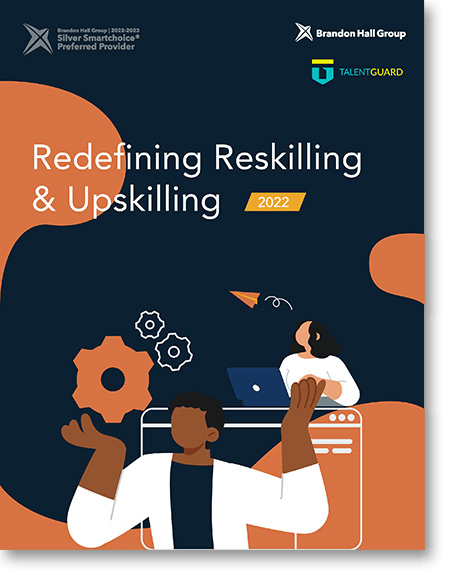
eBook: Redefining Reskilling & Upskilling
New research from Brandon Hall Group dives into everything you need to know to better manage and develop your employees skills through reskilling and upskilling.
Both paths lead to the same outcome — Skills Truth and Readiness Intelligence.
The question is: where are you starting from?
Prepare for your TalentGuard Discovery Conversation. Check out our guide for the call.