Your 2030 Leaders Need Development
Most talent review processes are built around a trigger: someone announces they are leaving. That’s the problem. By the time the departure is visible, the readiness gap has already been forming for years. And if your organization is like most, that gap is not sitting at the top of the house. It’s sitting one or two levels below it. The talent review process — the structured exercise HR calls a “talent review” and the board calls “succession planning” — gets the C-suite right and the VP layer wrong. That’s where the cost is hiding.
CEO succession gets the board attention, the structured process, and the named candidates. The VP and senior management layer gets a spreadsheet updated once a year and a conversation at the annual talent review. That layer is also where most of the business functionally happens.
The Talent Review Process, Defined
Before getting to where it fails, it’s worth being explicit about terms. HR practitioners typically call the structured exercise of evaluating leadership pipeline readiness a “talent review process” or “talent calibration.” Boards and CEOs typically call the same exercise “succession planning.” The two terms describe substantially the same work — assessing who’s ready for which role, identifying gaps, and building development pathways to close them.
In this article, we use “talent review process” because that’s the practitioner vocabulary. But everything that follows applies equally to succession planning — and the strongest organizations recognize that the two are not separate processes but the same process described from two different vantage points.
A complete talent review process answers four questions:
- Which roles, if vacant, would materially disrupt operations or strategy?
- Who could realistically fill each of those roles, at what readiness level?
- What does the gap between current capability and future requirement look like?
- What development pathway closes that gap before the need becomes urgent?
If your talent review process doesn’t answer all four — and most don’t, at the VP level — you have a pipeline visibility problem that’s compounding silently.
The Pipeline Problem Hiding in Plain Sight
Pinsight’s 2026 research on Director and VP-plus succession puts the risk in plain language: the succession challenge is most acute below the C-suite, at the Director and VP levels where strategy gets translated into execution. Readiness at those levels is least validated and risk is most concentrated.
The financial consequence of getting it wrong is not immediate, but it’s not abstract either. A failed promotion at the Director level costs between $660,000 and $1.1 million. At the VP level, that figure rises to $960,000 and $1.6 million. McKinsey research puts the rate of leadership transition failure or underperformance at approximately 50%.
For boards, the risk shows up when the organization is asked to prove a successor is ready. Most cannot answer that question. Not because they lack data — they almost always have plenty. Because they lack the right data organized around the right question: what does this specific role require, and how close is this specific person to meeting that requirement?
That question is the entire point of a talent review process. Most talent reviews never get there.
The Development Timeline Does Not Compress
Here’s the constraint that makes this urgent right now. The development timeline from senior individual contributor to VP runs three to five years under normal conditions. Organizations cannot manufacture that runway after the fact. They can only use the runway they built in advance.
When a VP-level role opens unexpectedly, organizations face a version of the same decision every time: promote someone who isn’t quite ready and absorb the risk, conduct an external search that takes months and costs a multiple of the annual salary, or leave the role in interim status while the business waits. None of those options are good. All of them are more expensive than the development investment that would have prevented the exposure in the first place.
Pinsight’s study documents the shift already underway. Forward-thinking organizations now run talent review processes that identify succession risk across multiple leadership tiers, building plans for senior leaders, department heads, and technical experts — not just the C-suite. The organizations that haven’t made that shift are the ones that risk absorbing the cost of unplanned transitions at scale.
Why VP and Senior Management Talent Reviews Fail
The root of the problem is how most organizations assess readiness during the talent review process at these levels. Decisions rely on indirect signals: past performance ratings, manager judgment, perceived potential, informal reputation. Those signals have value. They don’t answer the question a succession decision requires: will this person perform under increased complexity, in a role with different demands than the one they currently hold?
Pinsight’s research identifies the core gap directly. Organizations don’t lack assessment data. They lack the ability to turn that data into defensible evidence of readiness at the levels where leadership transitions happen most frequently and at the greatest scale.
The result is a familiar pattern. A high-potential Director gets labeled “ready” during the talent calibration session. The label is based on strong performance in their current role, positive stakeholder relationships, and consistent ratings. Nobody has mapped the specific skill and proficiency requirements of the VP role they’re being considered for. Nobody has documented what the gap between current capability and future requirement looks like. The promotion happens on instinct, backed by good intentions.
McKinsey Senior Partners Scott Keller and Colin Price documented in Leading Organizations: Ten Timeless Truths that approximately 50% of leadership transitions fail or underperform. The title has aged better than most business books. The finding has not changed.
What an Effective Talent Review Process Actually Requires at This Level
Closing the VP and senior management succession gap requires three things most talent review processes do not have in place.
First, documented role blueprints that define what each leadership role demands in terms of skills, proficiency levels, and behavioral requirements. Not a job description. A skills-based specification precise enough to measure against.
Second, an honest, structured assessment of where each succession candidate currently stands relative to those requirements. Not a performance rating. A readiness gap analysis grounded in multiple evidence sources — skills proficiency, behavioral assessment, and multi-source feedback. We’ve written more about the multi-layer readiness framework that makes this possible for organizations moving beyond manager-rated potential.
Third, a development pathway that moves each candidate from where they are toward where the role requires them to be, with defined milestones, named owners, and enough runway to make the journey before the need becomes urgent.
Without those three elements, the talent review process is a list of names on a slide. With them, it’s a defensible, continuously updated picture of pipeline health that holds up when the stakes are highest.
How a Modern Talent Review Process Differs From the Annual Exercise
Most organizations still treat the talent review process as an annual event. One day on the calendar. Slides reviewed by the executive team. Names confirmed for the high-potential list. The output goes in a binder until next year.
A modern talent review process operates differently:
| Traditional Annual Talent Review | Modern Continuous Talent Review |
|---|---|
| One-day exercise per year | Continuous evidence accumulation with quarterly review touchpoints |
| Manager-nominated candidates | Skills-based identification with multi-source validation |
| Performance rating + potential rating | Skills proficiency + behavioral assessment + 360 feedback |
| 9-box grid as the primary tool | Role-specific readiness scoring against role blueprints |
| Output: ranked talent lists | Output: defensible pipeline visibility with documented gaps |
| Reviewed annually; updated never | Updated continuously as skills, performance, and feedback evolve |
| Defensibility: low | Defensibility: high — audit-ready by design |
The difference matters most at the VP and senior management layer, where the consequences of a bad decision are highest and the traditional approach is most likely to miss the actual readiness picture.
The Organizations Already Getting This Right
The organizations getting ahead of this build the talent review process as a continuous system, not a reactive event. They maintain living pipeline maps, tie development plans directly to role requirements, and above all know, at any point, which roles carry the highest succession risk and which candidates are on track to close the gap before the clock runs out.
What separates their talent review process from the traditional version is structural, not procedural:
- Role blueprints exist for every critical role, not just the executive layer
- Readiness is measured against role-specific criteria, not generic performance frameworks
- Multiple evidence sources feed each readiness assessment — skills, behavioral, multi-source feedback
- Development pathways are documented and tracked, not assumed
- Pipeline visibility is continuous, not annual
- Decisions are defensible at the board level, not just at the talent review meeting
For a deeper look at the underlying methodology, see the modern succession planning framework and the four stages of succession planning. For the practical starting point, our free succession planning template operationalizes role blueprints and readiness gap analysis in editable workbook form.
How TalentGuard Supports the VP and Senior Management Talent Review
TalentGuard’s succession and internal mobility solutions give organizations the skills-based infrastructure to build exactly the talent review process described above — from role blueprints and readiness assessments through development pathways and pipeline visibility.
Five capabilities matter most for VP and senior management succession:
- Role blueprints with skills profiles for every critical role, not just C-suite
- Multi-layer readiness scoring that combines skills proficiency, behavioral assessment, and 360 feedback into a defensible composite signal
- Continuous pipeline visibility showing risk concentration and readiness coverage at every leadership tier
- Documented development pathways with named owners, milestones, and progress tracking
- Audit-ready decision trails that hold up under board, audit, and regulatory scrutiny
See how it works for your VP and senior management layer. Book a 15-minute walkthrough or explore the TalentGuard platform.
What to Read Next
- Want to understand the underlying readiness methodology? Read the modern succession planning framework.
- Want the full succession planning process? Read the four stages of succession planning.
- Want to know why most succession plans fail? Read why succession plans fail and how to fix them.
- Ready to operationalize role blueprints and readiness assessments? Download our free succession planning template.
- Ready to see TalentGuard’s platform in action? Book a 15-minute walkthrough.
FAQs
What is the talent review process?
The talent review process is the structured exercise organizations use to evaluate leadership pipeline readiness — assessing who is ready for which roles, identifying gaps, and building development pathways to close them. HR practitioners typically call this a “talent review” or “talent calibration”; boards and CEOs typically call the same exercise “succession planning.” The two terms describe substantially the same work from different vantage points.
What’s the difference between talent review and succession planning?
Talent review and succession planning describe the same underlying work in different vocabulary. “Talent review” is the practitioner term used in HR; “succession planning” is the term used at the board and executive level. The most effective organizations recognize they’re not separate processes but the same process — and design their operating model accordingly rather than running parallel exercises with different inputs.
Why do most talent review processes fail at the VP level?
Most talent review processes were designed for executive succession and treat VP-level succession as an extension of the same approach. The problem is that VP-level decisions require role-specific evidence — what does this particular VP role demand, and how close is this particular candidate? — that generic “high performer / high potential” frameworks can’t produce. Research suggests roughly 50% of leadership transitions fail or underperform; the failure rate is highest at the VP level where structural support is weakest.
What does an effective talent review process include?
An effective talent review process includes three structural elements that most traditional reviews lack: documented role blueprints defining the specific skills and proficiency levels each critical role requires, structured readiness assessment grounded in multiple evidence sources (skills, behavioral assessment, multi-source feedback), and documented development pathways with named owners and clear milestones. Without all three, talent reviews produce lists of names rather than defensible pipeline visibility.
How often should the talent review process happen?
Traditional talent reviews happen once a year. Modern talent reviews are continuous — evidence accumulates constantly as skills, performance, and feedback evolve, with formal review touchpoints quarterly on critical roles and semi-annually for comprehensive pipeline review. Annual snapshots produce stale data that’s already out of date by the time it’s consulted in actual transitions.
What is talent calibration?
Talent calibration is the practice of reviewing manager-assigned talent ratings across multiple managers to ensure consistency — preventing situations where one manager rates everyone “high potential” while another rates equivalent employees “average.” Calibration is one component of the broader talent review process. The structural limitation of calibration is that it can only correct inconsistency in subjective ratings; it can’t replace the underlying subjectivity. Evidence-based readiness assessment addresses the deeper problem.
What is a 9-box talent review?
A 9-box talent review uses a 3×3 grid plotting employees on two dimensions: current performance and assessed potential. Each employee lands in one of nine boxes (high performance / high potential through low performance / low potential). The 9-box is a visualization tool, not an assessment framework — the underlying ratings still come from manager opinion. Better visualization, same underlying subjectivity. Modern talent review processes are moving beyond the 9-box toward evidence-based readiness assessment.
What is the cost of failed VP succession?
Research suggests a failed VP-level promotion costs between $960,000 and $1.6 million, including recruiting costs for an external replacement, transition disruption, lost productivity, and impact on the team and stakeholders. Director-level failures cost between $660,000 and $1.1 million. These numbers don’t include the harder-to-quantify costs of damaged stakeholder confidence and lost institutional knowledge during the failed transition.
How long does it take to develop a VP-level successor?
The development timeline from senior individual contributor to VP runs three to five years under normal conditions. The runway can’t be compressed after the fact. Organizations either invest in development in advance — which produces ready successors when transitions occur — or absorb the cost of bad transitions when the time comes. There’s no shortcut.
How does the talent review process connect to succession planning?
The talent review process and succession planning are two names for substantially the same work. The talent review process is the practitioner-led exercise that produces succession planning outputs — identifying critical roles, assessing readiness, building development pathways. Organizations that run them as separate processes typically maintain two versions of the same data with conflicting outputs. Organizations that treat them as one process with two audiences (HR/practitioner vocabulary and board/executive vocabulary) produce more consistent and more defensible succession decisions.
How does skills-based assessment change the talent review process?
Skills-based assessment replaces manager-rated potential with validated competency data — turning the talent review process from a discussion of subjective judgments into a review of objective evidence. The shift produces more accurate readiness assessment, more defensible succession decisions, and dramatically reduced bias. We’ve written more about how skills-based succession planning eliminates leadership bias for organizations evaluating the shift.
See a preview of TalentGuard’s platform
The End of “High Potential”: Why Boards Are Demanding Readiness Proof
For decades, succession planning lived in the comfortable ambiguity of potential, with little real visibility into succession planning readiness. Boards would convene, HR would present a slate, and somewhere in the conversation, a similar phrasing would emerge: she has what it takes. He’s a natural leader. Give it two years. That era is ending. New […]
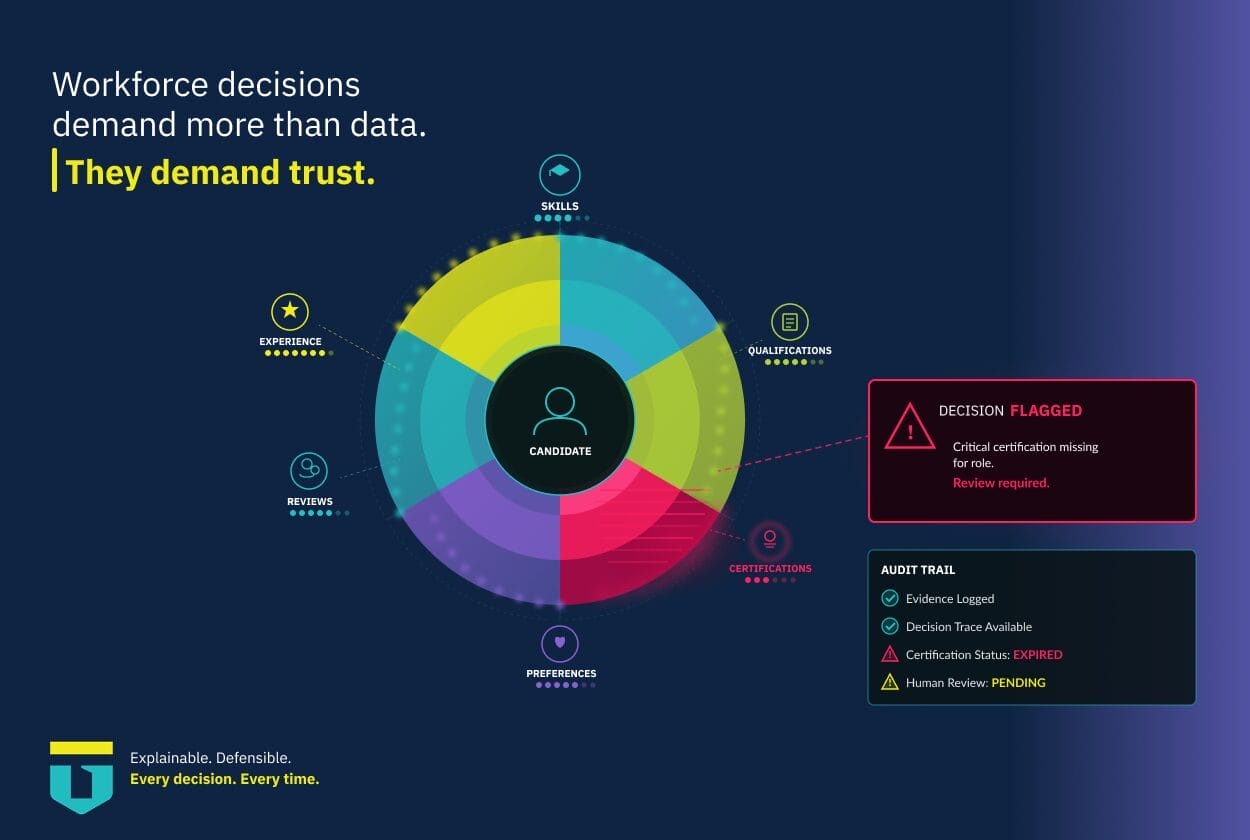
When AI Gets HR Wrong: The Accountability Framework Every Talent Leader Needs
The HR technology industry has a contradiction it needs to answer for. These are the companies whose entire market value is built on helping other organizations attract, develop, and retain human talent. They sell workforce intelligence. They advise CHROs on engagement, retention, and the future of work. In the first quarter of 2026, they are […]
The New Workforce Intelligence Standard: What the Mobley Ruling, the EU AI Act, and Board Succession Reviews Now Require
Something quiet has happened in the last eighteen months, and most workforce intelligence leaders haven’t named it yet. A federal court, a regulatory body, and a corporate governance committee — three institutions that rarely share a vocabulary, much less a question — have each independently started asking workforce systems to produce the same thing. Not […]