Succession Planning Software
Succession Planning
Requires Truth.
Not Just Intention.
Most organizations have a succession plan. Few have a defensible one. TalentGuard converts fragmented talent signals into governed, auditable succession decisions — built on a verified foundation of skills truth and powered by real-time intelligence.
THE PROBLEM
Why Most Enterprise Succession Programs Fail
The failure is rarely strategic intent. It is a data infrastructure problem masquerading as a talent strategy problem.
Most organizations treat succession planning as a calendar event — an annual review, a 9-box exercise, a list of names attached to a slide deck. The intent is right. The infrastructure is not.
Without verified skills intelligence, governed criteria, and real-time readiness monitoring, succession programs produce preferences — not decisions. And preferences do not hold up when a board asks why one candidate was designated over another, when a regulator asks how readiness was determined, or when a role opens unexpectedly and the organization discovers its plan was built on data that no longer reflects reality.

Plans without Data
Succession plans built on résumés, tenure, and manager opinion are not plans — they are preferences. Without verified skills intelligence, organizations are making multi-million-dollar continuity decisions on anecdote.

Fragmented Talent Signals
Skills data lives in disconnected systems — HCM, LMS, performance platforms, project tools. Without a unified, normalized layer, no one can answer the foundational question: Who is actually ready?

No Auditability
When a board asks “why was this successor chosen?” most HR teams cannot answer with precision. Decisions backed by governed data are defensible. Decisions backed by intuition are a liability.

Skills Drift Goes Undetected
Roles evolve. The critical skills for a position today are materially different from what they were 18 months ago. Static succession plans are invalidated silently — with no alert, no remediation trigger.
Succession Is Where Readiness Intelligence Becomes Its Most Consequential Decision
Talent Assessment validates whether individual skills are real. Career Pathing maps the route to readiness. Development Planning closes the gaps.
“Succession Planning is where all of that converges — the Readiness Engine module that answers the highest-stakes readiness question an organization faces: When a critical role becomes vacant, do we have a verified, ready candidate — and can we prove it?
The output of a governed succession program is not a bench list. It is a defensible decision record — with verified readiness scores, governed criteria, documented rationale, and a complete audit trail — that flows directly into Talent Insights, where it becomes board-ready succession intelligence leadership can act on and stand behind.
Succession’s unique angle on readiness: Prioritizes it. Determines which candidates are most ready for which critical roles — right now — with evidence that holds up to any level of scrutiny.
What Is Succession Planning
— Precisely?
“Succession planning is the systematic process by which an organization identifies, assesses, and prepares internal candidates to assume critical roles — ensuring leadership and operational continuity without dependence on external hiring.”
At its core, succession planning is a governance function. It answers a board-level question: if a critical role became vacant tomorrow, does the organization have a verified, ready candidate — and how would it prove that?
Effective succession planning extends beyond identifying a “next in line.” It requires continuous assessment of role criticality, candidate skill readiness, development gap remediation, and organizational bench depth — all governed by a consistent methodology that can withstand internal and external scrutiny.
The distinction between a succession list and a succession program is defensibility. A list names people. A program demonstrates readiness — with verified data, transparent criteria, and an auditable decision trail.
From Fragmented Signals
to Defensible Decisions
The ESTRI chain is the operational logic that converts raw talent data into board-ready succession intelligence.
Skills Truth
Governance
Readiness
Auditability
What Succession Planning
Looks Like in Practice
A governed succession program is not a single event — it is a continuous operational cycle.
- Identify roles whose vacancy would cause material operational or strategic disruption
- Maintain a live critical role registry — updated as the organization evolves
- Score criticality by revenue impact, replaceability, institutional knowledge concentration
- Prioritize succession investment based on objective risk exposure
- Surface internal candidates based on governed skill match to critical role requirements
- Account for performance trajectory, not just current state
- Apply readiness scoring: Ready Now, Ready in 1–2 Years, Development Candidate
- Eliminate pattern-matching bias through structured, criteria-based evaluation
- Identify precise skill gaps between current state and role-readiness threshold
- Assign learning, experiences, and mentorship with measurable milestones
- Generate targeted Individual Development Plans (IDPs) aligned to gap closure
- Track development velocity — ensure readiness timelines remain accurate
- Conduct structured succession reviews on a defined cadence (quarterly/annually)
- Apply diversity, equity, and inclusion overlays to pipeline composition
- Present bench health reports to HR leadership and board as required
- Document all review decisions with rationale for auditability
- Trigger succession protocol when critical roles are vacated or at risk
- Alert succession managers when candidate readiness degrades below threshold
- Monitor role evolution for skills drift that invalidates existing readiness scores
- Maintain a closed-loop system: activation data refines future assessments
Built for the Complexity of Enterprise Succession
Every capability in TalentGuard’s succession module is designed around one requirement: defensibility.

Unified Skills Ontology
Normalize skills data across every connected system into a single, governed taxonomy. Eliminate definitional inconsistency that undermines assessment validity.

Role-Skill Mapping Engine
Define precise skill profiles for every critical role — including proficiency thresholds, criticality weights, and future-state requirements as roles evolve.

Real-time Readiness Scoring
Quantify bench readiness continuously, not annually. Readiness scores update as candidate skills change, role requirements shift, and assessments are completed.

Succession Depth Analytics
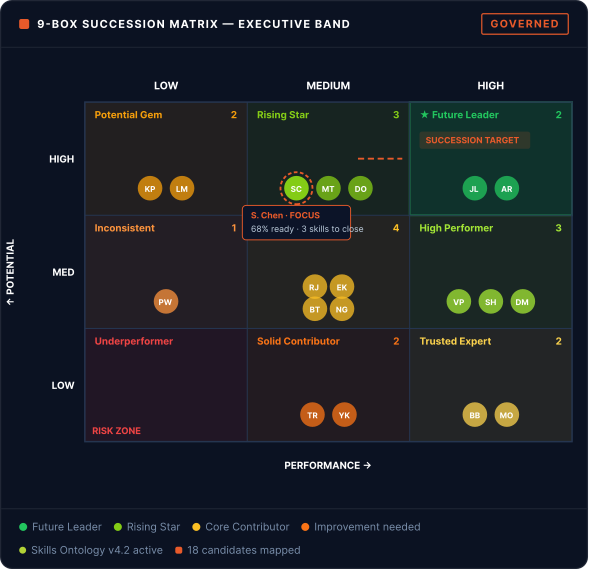
Visualize bench depth across the critical role portfolio. Identify concentration risk, single points of failure, and under-invested pipeline segments.

Governed Candidate Management
Track candidates through succession pools with criteria-based designation, structured review workflows, and complete history of all assessments and decisions.

Diversity Overlay
Apply configurable equity lenses to succession pipelines. Surface representation gaps, flag homogeneous pools, and report on diversity progress across bench composition.

Skill Drift Monitoring
Receive automated alerts when role requirements evolve beyond a candidate’s current skill profile. Succession plans stay current without manual intervention.

Audit-Ready Reporting
Generate board-ready succession reports, regulatory compliance documentation, and complete decision audit trails — on demand, at enterprise scale.
The Standard vs. The
Governed Approach
Most succession tools manage a process. TalentGuard governs an outcome: defensible readiness.
Trusted by Organizations That Cannot Afford to Be Wrong
Global Financial Services
Multinational Manufacturing
Technology Enterprise
Professional Services Group