Certification Tracking Software
Certifications That Expire
are a Liability
Certifications that Govern
are an Asset
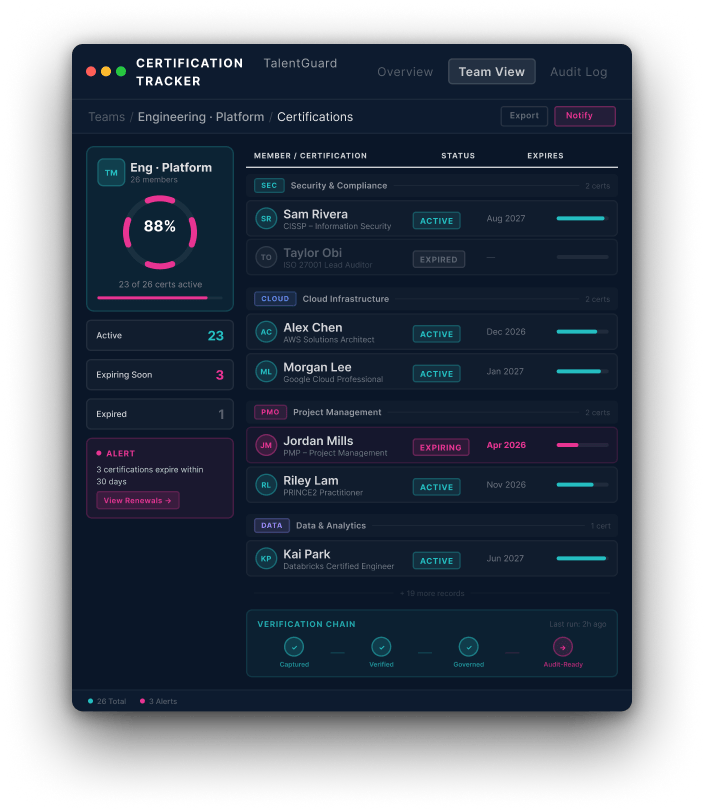
TalentGuard’s Certification Tracking does more than remind you when a license is due. It connects every verified credential to role requirements, readiness scores, and talent decisions — so certifications become part of your workforce intelligence, not a compliance checklist that lives in a spreadsheet.
Credential Visibility Across Roles
3.4X
Faster Compliance Audit Completion
40%
Reduction in Certification Lapses
What Breaks Without Governed Certification Tracking
Most Enterprises Have Certification Data. Very Few Have Certification Governance.
There is a meaningful difference between having records of your workforce’s certifications and having a governed system that makes those credentials visible, verified, current, and connected to decisions.
Most organizations operate somewhere in the middle. certifications captured in spreadsheets, LMS completion logs, or HRIS fields that no one is actively monitoring. The result is predictable: lapses go undetected, audits expose gaps, and credentialed talent is invisible at the moment it matters most.
The four failure modes that create compliance risk aren’t about effort. They’re about infrastructure.
Fragmented Records
Certifications live in spreadsheets, email attachments, and siloed HR systems. There is no single, structured source of truth accessible to the people who need it.
Expiration Blind Spots
Without automated monitoring, credential lapses go undetected until an audit exposes a compliance gap — creating legal, operational, and reputational risk.
Unverifiable Claims
Self-reported credentials cannot be audited, cross-referenced, or defended. When regulators ask for evidence, enterprises cannot produce it reliably.
Disconnected from Deployment
Certification data does not reach hiring managers, project leads, or workforce planners. Credentialed talent is invisible at the point of decision.
The consequence:
Organizations invest in credentialing programs, require certifications for critical roles, and assume the data is being managed — then discover at audit time that the infrastructure was never there.
What is Certification
Tracking Software?
Certification Tracking Software is a governed system for capturing, validating, monitoring, and operationalizing workforce certifications — including professional licenses, industry credentials, regulatory compliance requirements, and internal training completions.
Most certification tracking tools stop at record-keeping and expiration alerts. TalentGuard connects certification data upstream to role requirements and downstream to readiness scores — making credentials an active input to workforce intelligence, not a static compliance archive.
CERTIFICATION Is Not
- An LMS or learning delivery platform
- A digital badge or micro-credential issuer
- A performance review or 360 feedback tool
- A skills inference or AI prediction engine
CERTIFICATION Is
- A governed system of record for all workforce certifications
- A compliance infrastructure layer for regulated industries
- A decisioning input for workforce planning and deployment
- An audit-ready evidence base for stakeholders
Certification as Skills Evidence
A Verified Credential Is One of the Strongest Forms of Skills Evidence.
In the ESTRI framework, certifications are not a compliance category — they are a primary evidence source for measuring whether skills data can be trusted. A verified professional license, a renewed industry credential, or a completed regulatory training are among the highest-quality evidence artifacts that can back a skill claim in an enterprise skills record.
This is why TalentGuard’s Certification Tracking is not a standalone compliance module. It is an evidence layer feeding directly into ESTRI’s Skills Trust Foundation metrics. Three ESTRI metrics directly strengthened by governed certification data:
ESTRI Metric 01
Evidence-Backed Skills Rate
The percentage of skill records supported by at least one qualifying evidence artifact.
Verified certifications are qualifying evidence. Every governed credential record lifts this metric — and every unverified or lapsed certification is a gap in the evidence base.
→ Target benchmark: ≥ 65% evidence-backed
ESTRI Metric 02
Skills Currency Index
The proportion of critical skill records refreshed within their defined currency window.
Certification renewal data is the most structured available signal for skills currency in regulated roles — because renewal requirements enforce a defined recency standard by design.
→ Target benchmark: ≥ 80% within currency window
ESTRI Metric 03
Decision Defensibility Rate
The percentage of formal talent decisions linked to a complete, auditable skills evidence chain.
In roles where certification is a requirement, a lapsed credential creates a break in the evidence chain — making any promotion or succession decision structurally indefensible.
→ Target benchmark: ≥ 90% traceable decisions
Connection callout:
Certification Tracking feeds governed credential evidence into Talent Insights → ESTRI metrics → Workforce readiness decisions.
See how Talent Insights uses this data →
Six Stages. One Governed Certification Record | TalentGuard enforces a disciplined governance chain that transforms raw certification data into operational workforce intelligence — with full auditability at every stage. No manual handoffs. No unverified claims surfacing in talent decisions. |
Built for Regulated Industries
Certification Governance Is Not Optional in High-Stakes Industries.
The consequences of credential failure vary by industry — but in regulated environments, they are never minor. TalentGuard’s Certification Tracking is designed to meet the compliance infrastructure requirements of industries where credential governance is a business-critical function, not an HR administrative task.

Healthcare & Life Sciences
Clinical licensure, continuing education requirements, DEA registrations, and accreditation standards require continuous, auditable monitoring. A single lapsed credential in a patient-facing role creates immediate regulatory and liability exposure.
Credential types managed: Clinical licenses, DEA registrations, BLS/ACLS certifications, Joint Commission requirements, state-specific licensure.

Financial Services & Banking
FINRA registrations, Series licenses, AML training, and state-specific broker-dealer requirements are subject to regulatory examination. The inability to produce a complete credential record on demand is itself an audit finding.
Credential types managed: FINRA Series registrations, CFP/CFA designations, AML/BSA training completions, state insurance licenses.

Energy, Utilities & Infrastructure
OSHA certifications, safety training completions, operator qualifications, and environmental compliance credentials must be continuously monitored and documented for field deployment decisions.
Credential types managed: OSHA 10/30 certifications, operator qualifications, safety training records, environmental compliance credentials

Technology & Professional Services
Vendor certifications (AWS, Azure, Cisco, Salesforce), security clearances, and professional designations are critical signals for project staffing, client delivery, and competitive positioning — and they expire on schedules most organizations aren’t actively tracking.
Credential types managed: Cloud platform certifications, cybersecurity credentials, professional designations, vendor-specific qualifications
FAQ's: Certification Tracking & Credential Governance