SKILL TRUST – ESTRI PILLAR ONE
Intelligent Role Studio: The Governed Content Core Your Entire Talent Platform Depends On
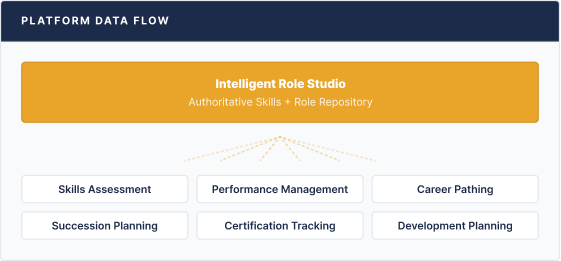
Every assessment score, career pathway, development plan, succession decision, and workforce insight produced by TalentGuard draws from one authoritative source. IRS is that source — the governed content management system where AI-generated skills and role data is reviewed, approved, versioned, and published as the Skills Truth that makes every downstream decision defensible.
THE PROBLEM
Most Enterprises Do Not Have Trusted Skills Data. They Have Skills Chaos.
The problem is not that organizations lack skills data. The problem is that the skills data they have cannot be trusted, and therefore cannot support the talent decisions that depend on it.
When every system maintains its own skills vocabulary, job profiles are owned by no one, AI-generated content is published without review, and role definitions are last updated three budget cycles ago — every talent process built on that foundation inherits the same risk.
Assessments measure employees against standards no one has validated. Career pathways lead to roles defined inconsistently across regions. Succession decisions are made on readiness scores no one can explain. And when a board, regulator, or legal team asks how a talent decision was reached — there is no traceable answer.
This is the enterprise skills governance failure. IRS is its solution.
Four Failure Modes IRS Eliminates
solution: Intelligent Role Studio
The Content Core
IRS Is Not a Feature. It Is the Infrastructure That Makes Skills Truth Possible.
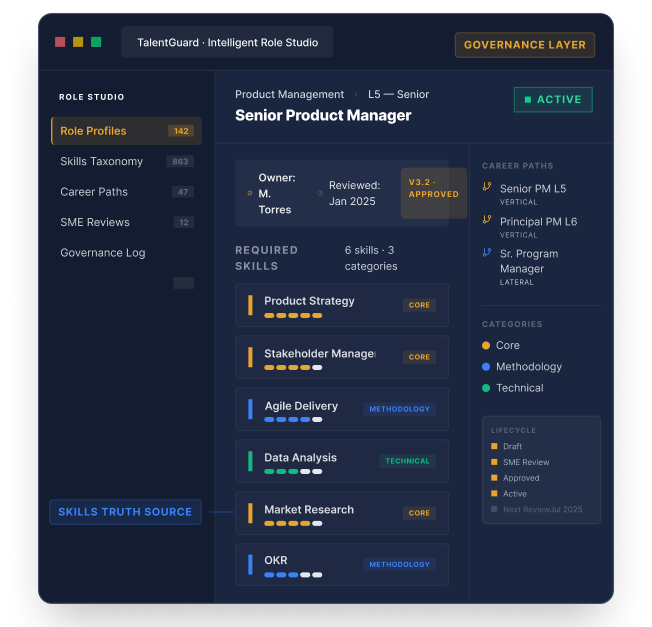
Intelligent Role Studio is TalentGuard’s governed content management system for enterprise role and skills data. Where other platforms treat role and skill definitions as configuration — something set up once and forgotten — TalentGuard treats them as governed enterprise assets with defined ownership, structured lifecycle management, audit trails, and real-time propagation to every module that depends on them.
IRS is where WorkforceGPT’s AI-generated outputs become organizational truth. Every skill definition, job profile, proficiency standard, career progression, and learning reference that passes through IRS has been reviewed by an SME, approved through a governance workflow, versioned, and published — making it authoritative, current, and defensible at the moment it enters any talent process.
Core Responsibilities
- ✓Manage a unified skills + job architecture
- ✓Build and maintain skills-based job profiles (responsibilities, skills, learning references)
- ✓Define career progressions and role relationships for career pathing
- ✓Invite SMEs to contribute and refine content collaboratively
- ✓Serve as the single source of truth feeding consistent data into all TalentGuard modules
Six functions. One governed system.
Each capability in Intelligent Role Studio is designed to eliminate a distinct failure mode in enterprise skills data management.
From fragmented signals to defensible decisions.
IRS converts raw skills data into governed Skills Truth through a three-pillar framework. Each pillar addresses a distinct governance failure that undermines enterprise talent strategy.
Standards
IRS establishes and enforces a normalized skills taxonomy—the agreed vocabulary for what skills mean, how they are named, and how proficiency is measured. No ambiguity. No duplication.
- Normalized skill naming and definitions
- Proficiency scale standardization
- Supports bespoke frameworks already built
- Controlled vocabulary management
Governance
Every role profile and skill definition has an assigned owner. Changes require approval. The system maintains a complete provenance record of who changed what, when, and why.
- Role and skill ownership assignment
- Approval workflows
- Review cycles management
- Audit log with user attribution
Lifecycle
Skills and roles are not static. IRS manages the full content lifecycle—from initial creation through active use to deprecation—ensuring organizational data remains current and defensible.
- Draft → Active → Archived
- Reminders & Notifications
- Version history
- Re-assignment of SME
→
→
→
→
→
→
Skills Trust
What we mean by “Skills Trust”
Skills Trust is not a marketing construct. It describes the state in which an organization’s skills and role data is authoritative, governed, current, and auditable—and the same data informs every talent decision across the enterprise.
Skills Trust is the precondition for every meaningful skills-based initiative. You cannot assess accurately against a role you have not defined precisely. You cannot build a learning path toward a skill your system does not recognize. You cannot defend a promotion decision made on unverifiable criteria.
What governed Skills Truth delivers.
The value of IRS is not in the technology. It is in what becomes possible when your organization operates from a single, authoritative understanding of skills and roles.
 DEFENSIBILITY
One skills vocabulary across all systems and processes
Assessment, learning, planning, and mobility all draw from the same governed role and skills data. Decisions made in different functions are now comparable and coherent.
CONSISTENCYEvery talent decision backed by traceable evidence
When a promotion is questioned, a succession decision is reviewed, or a workforce reduction requires documentation, IRS provides the data lineage to explain and defend every outcome.
 READINESS
Accurate workforce readiness without reconciliation overhead
Because skills data is maintained at the source, readiness reports are accurate in real time. No manual reconciliation between systems. No reconciliation debt accumulating in the background.
 ADAPTABILITY
Full compliance with governance requirements
IRS creates a complete audit trail for role definitions, skills standards, and profile changes. Organizations subject to EEOC, ISO, or internal audit requirements have the documentation they need.
Without IRS
- ▪ Skills defined differently across HR, L&D, and Finance
- ▪ Job profiles maintained manually, often out of date
- ▪ No single owner for role content accuracy
- ▪ Talent decisions cannot be reconstructed or defended
- ▪ Every module operates on its own data assumptions
With IRS
- ▪ One authoritative taxonomy governs all skills language
- ▪ Profiles version-controlled with SME validation workflows
- ▪ Assigned owners with review cycles and change approvals
- ▪ Decisions traceable to governed role requirements
- ▪ All modules share a single accurate data foundation