Performance Readiness

Measure Progress Against 
Role standards 

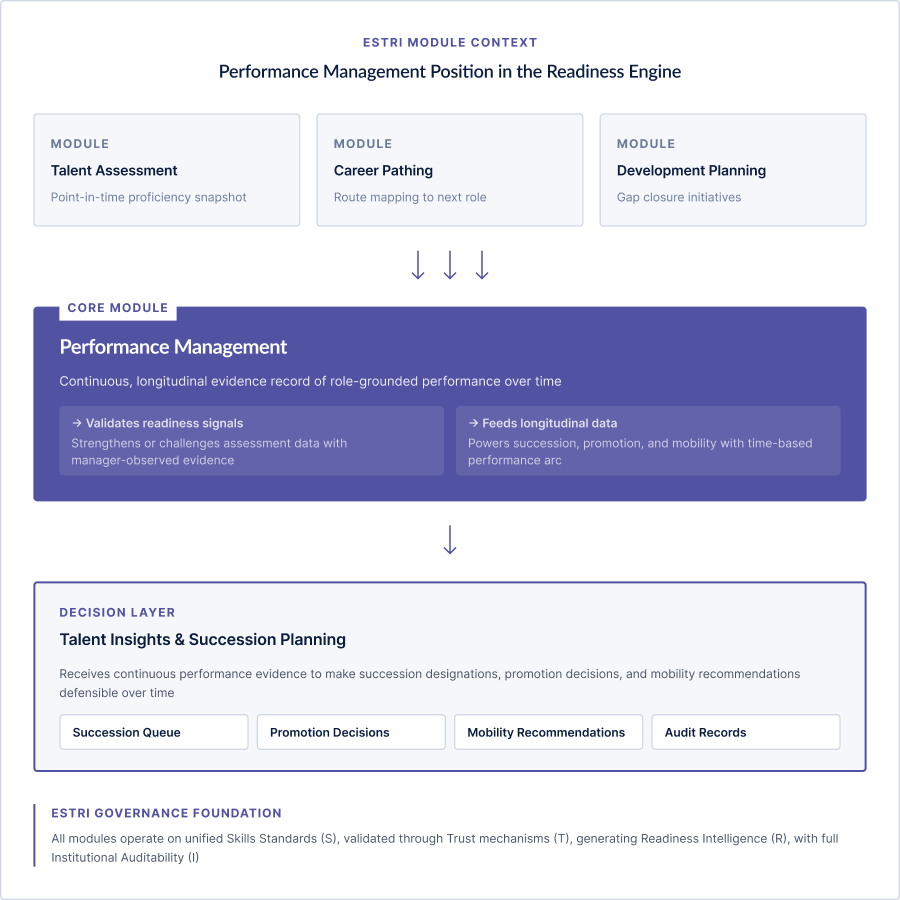
TalentGuard operationalizes enterprise performance management by connecting role expectations, measurable objectives, skills proficiency, and observed outcomes into a single trusted system. Reviews move beyond subjective ratings to structured evaluations aligned to governed workforce standards.

Consistent → Explainable → Auditable

TalentGuard Performance-Management
73%
of enterprise HR leaders cite inconsistent skills data as a barrier to performance decisions
4.2x
more likely to retain talent when performance management is skills-grounded
61%
of regulated industries face audit risk from undocumented performance criteria

DEFINITION

What is a Performance Management?


WORKING DEFINITION

Employee Performance Management (EPM) is the systematic, governed process by which organizations define workforce standards, measure individual and team capabilities against those standards, evaluate contributions in the context of role requirements, and drive structured improvement—translating skills intelligence into auditable organizational outcomes.

The Legacy Interpretation

Historically, performance management was reduced to annual review cycles, manager-led rating scales, and disconnected goal-setting exercises. It treated performance as an event rather than a continuous intelligence process.

  • Subjective manager ratings without standards alignment
  • Disconnected from skills taxonomy or role benchmarks
  • Point-in-time evaluations with no readiness context
  • Indefensible under regulatory or legal scrutiny
The Enterprise Intelligence Standard

In modern enterprise practice, EPM is a governed intelligence discipline—a continuous system that connects defined skills standards, structured assessments, and readiness intelligence into a single, auditable record of workforce capability.

  • Skills-grounded standards with role-level precision
  • Governed taxonomy aligned across the full workforce
  • Continuous readiness scoring, not periodic rating
  • Fully auditable, defensible performance records

The critical distinction

Performance management without a governed skills foundation produces opinions. Performance management built on Skills Truth—validated, standards-aligned capability data—produces defensible intelligence. This distinction determines whether your performance system passes audit, supports legal review, and drives genuine organizational improvement.

01  —  ENTERPRISE PROBLEM

The Performance
Intelligence Gap

Most enterprise organizations have performance management processes. Few have performance management intelligence. The gap between the two is the source of persistent talent, compliance, and organizational risk.

01
DATA INTEGRITY RISK
Fragmented Skills Signals

Skills data is distributed across LMS platforms, HRIS records, manager assessments, and informal observations—with no unified
standard governing what each data point means or how it was validated.

ORGANIZATIONAL SYMPTOMS
  • No single source of truth for workforce capability
  • Incompatible data formats across business units
  • Skills assessments with no normalization or calibration
  • Manual reconciliation consuming HR bandwidth

02
DECISION QUALITY RISK
Unverifiable Performance Standards

Performance criteria are defined locally, inconsistently, or not at all. Without a governed skills taxonomy, role benchmarks cannot be compared, and performance evaluation lacks the structural rigor required for enterprise-wide decisions.

ORGANIZATIONAL SYMPTOMS
  • Role profiles undefined or inconsistently maintained
  • Skill requirements vary by manager, not by role
  • No connection between role standards and assessment criteria
  • Calibration sessions produce subjective, unverifiable outcomes

03
COMPLIANCE & LEGAL RISK
Indefensible Performance Decisions

Promotion, succession, compensation, and development decisions cannot withstand legal, regulatory, or internal audit review
when performance management lacks a documented, standards-aligned foundation.

ORGANIZATIONAL SYMPTOMS
  • No audit trail linking decisions to skills evidence
  • Inconsistent evaluation criteria across protected groups
  • Succession plans not connected to verified readiness data
  • Regulatory reporting unsupported by underlying intelligence

DIAGNOSTIC QUESTIONS
What is exposed is your organization?
?
Can you produce a complete, verified skills profile for any employee within 24 hours?
?
Are your promotion decisions traceable to role-benchmarked capability evidence?
?
Does your performance criteria survive a consistency test across business units?
?
Could your succession plan withstand regulatory audit today?
?
Is your skills taxonomy governed by a central standard or defined locally?
?
Do your performance ratings correlate to verified capabilities or manager judgment?

02  —  CORE DISCIPLINES

The Five Disciplines
of Enterprise
Performance Management

Enterprise performance management is not a single activity. It is a discipline system—five interconnected
capabilities that, when governed together, convert workforce data into organizational intelligence.

01   FOUNDATION
Standards Architecture
The Foundational Discipline

Performance management without defined standards is opinion management. Standards architecture establishes the governed
taxonomy of skills, the behavioral anchors for each proficiency level, and the role-specific capability profiles that all
downstream processes depend on.

KEY COMPONENTS
Skills Taxonomy
Enterprise-wide classification of skills, sub-skills, and behaviors.
Proficiency Levels
Behavior-anchored descriptors from foundational to expert.
Role Profiling
Required capabilities mapped to each role at defined proficiency levels.
Taxonomy Governance
Change management protocols for standards maintenance and versioning.

02   EVIDENCE
Capability Assessment
The Evidence Discipline

Assessment converts standards into evidence. Structured, multi-modal evaluation—aligned precisely to role requirements—
produces the verified capability data that performance management depends on for credibility.

KEY COMPONENTS
Skills Assessments
Structured evaluation instruments aligned to proficiency standards.
Manager Validation
Calibrated manager evaluation within a structured rating framework.
360° Feedback
Multi-rater input structured around behavioral competency indicators.
Certification Integration
Third-party credentials and learning completions connected to role standards.

03   CONSISTENCY
Performance Calibration
The Consistency Discipline

Calibration ensures that performance evaluation is consistent, equitable, and comparable across managers, teams, and
business units—eliminating variance that undermines confidence in performance data.

KEY COMPONENTS
Calibration Workflows
Structured cross-manager review sessions with data-backed comparisons.
Bias Detection
Algorithmic flags for evaluator inconsistency and rating drift.
Distribution Analysis
Statistical monitoring of rating patterns across organizational units.
Normalization Protocols
Cross-unit harmonization ensuring comparability at enterprise scale.

04   DECISIONS
Readiness Intelligence
The Decision Discipline

Readiness intelligence quantifies the gap between current capability and required capability—converting assessment data
into a decision-grade score that supports promotion, succession, mobility, and development planning.

KEY COMPONENTS
Gap Analysis
Quantified distance between current and target capability profiles.
Succession Readiness
Bench-strength visibility for critical roles across the organization.
Readiness Scoring
Role-specific readiness score calibrated to decision thresholds.
Workforce Forecasting
Readiness trends and projected organizational capability demand.

05   GOVERNANCE
Compliance & Auditability
The Governance Discipline

Performance records must be defensible. The governance discipline creates and maintains the full documentation trail—from
standards definition through evaluation criteria—supporting decision-grade reporting for regulatory, legal, and internal review.

KEY COMPONENTS
Audit Trails
Immutable records of all performance actions linked to evidence.
Compliance Reporting
Regulatory-ready exports for EEOC, SOX, and industry-specific requirements.
Decision Documentation
Structured justification linking each decision to verified capability data.
Record Retention
Policy-driven retention schedules with role-based access controls.

03  —  HOW IT WORKS

From Fragmented
Signals to Defensible
Decisions

Our process converts raw workforce data—assessments, credentials, manager observations—into governed performance intelligence through five disciplined stages.

ESTABLISH
01
Define the Standards Foundation

TalentGuard works with your team to establish or import a governed skills taxonomy—mapping competencies, proficiency levels, and role requirements across your organization. This becomes the authoritative reference for all downstream performance activity.

KEY INPUTS
  • Existing job architecture
  • Functional competency models
  • TalentGuard WorkforceGPT generated
OUTPUT
Governed skills taxonomy + role profiles

ASSESS
02
Collect & Validate Capability Evidence

Structured assessments—aligned to your taxonomy standards—are deployed to collect capability evidence across the workforce. Multi-modal validation (self, manager, peer, system) produces confidence-scored capability data.

KEY INPUTS
  • Skills + self-assessments
  • Manager evaluations
  • Learning completions + credentials
OUTPUT
Verified, confidence-scored capability profiles

ANALYZE
03
Calculate Readiness & Surface Gaps

TalentGuard’s readiness engine compares verified capability profiles against role requirements—producing quantified gap scores for every employee, team, and business unit. Decision-grade readiness data replaces management intuition.

KEY INPUTS
  • Capability profile data
  • Role requirement benchmarks
  • Organizational structure mapping
OUTPUT
Readiness scores + prioritized gap intelligence

DECIDE
04
Support Defensible Performance Decisions

Performance reviews, calibration sessions, promotion decisions, and succession plans are executed within the platform—each action linked to verified evidence, maintaining the chain of documentation from standard to outcome.

KEY INPUTS
  • Readiness intelligence
  • Historical performance records
  • Calibration session outputs
OUTPUT
Documented, evidence-linked performance decisions

AUDIT
05
Maintain a Defensible Record

Every performance action—from assessment to decision—is preserved in an immutable audit trail. Compliance reports, legal reviews, and internal governance inquiries are supported by a complete, structured documentation record.

KEY INPUTS
  • Full decision history
  • Evidence chain documentation
  • Access and change logs
OUTPUT
Audit-ready, legally defensible performance record

04  —  PLATFORM CAPABILITIES

What TalentGuard Delivers

TalentGuard’s performance management platform operationalizes the ESTRI framework across six integrated capability domains—connecting every element of the intelligence chain from taxonomy to audit.

Skills Intelligence
Structured Skills Assessment
Define, govern, and version a unified enterprise skills library
Role Profiling Engine
Map required skills and proficiency levels to every role in the organization
Skills Gap Analysis
Quantify gaps between current capability and role requirements at any level

Assessment & Validation
Structured Skills Assessment
Deploy validated, taxonomy-aligned assessments across the workforce
2 Levels of Sign-off
Enable two levels of upward sign-off after the employee
Audit Trails
Immutable records linking every performance action

Performance Management
Goal Management
OKR and goal-setting connected to skills development
Review Workflows
Structured review cycles with configurable workflows
Development Planning
Individual development plans linked to gap analysis and continuous feedback

05
WHY TALENTGUARD
The Standard for
Enterprise-Grade
Performance
Most performance management platforms were built for engagement tracking, not intelligence governance.
TalentGuard was architected specifically for enterprise organizations where performance decisions must be
defensible, consistent, and auditable.

CAPABILITY AREAGENERIC HR PLATFORMSTALENTGUARD
Skills TaxonomyGeneric or imported taxonomy with limited role specificity
Enterprise-governed taxonomy with role-level proficiency anchors, maintained under change governance protocols
Assessment ValidationSelf-reported skills data with minimal validation structure
Multi-signal, confidence-scored assessment with structured manager validation
Performance CalibrationCalibration handled informally in meetings with no data support
Structured calibration with distribution analytics,
Readiness ScoringReadiness based on manager judgment or time-in-role proxies
Quantified capability-to-requirement gap analysis producing role-specific readiness scores for succession and mobility
Audit & ComplianceLimited documentation; difficult to reconstruct decision basis under review
Immutable audit trails linking every decision and export-ready compliance reporting
"TalentGuard's Performance management isn’t about tracking activity—it’s about creating the intelligence leaders need to make consistent, defensible talent decisions."
- Matt Zielke, Human Resource Service Excellence Lead, Ethos Energy

FAQs

Call to action Logo

Ready to Govern Your Workforce?

Schedule an Executive Demo