SKILLS TRUST – ESTRI PILLAR ONE
WorkforceGPT: The AI Engine
That Makes Your Skills Data Worth Trusting
Every workforce decision your organization makes — who gets promoted, who is ready for a critical role, who has the skills to execute on strategy — is only as reliable as the skills data underneath it. WorkforceGPT is how you make that data trustworthy.
THE PROBLEM WITH SKILLS DATA
You Cannot Govern what You Cannot Trust
The enterprise skills problem is not a shortage of data. It is a shortage of trustworthy data.
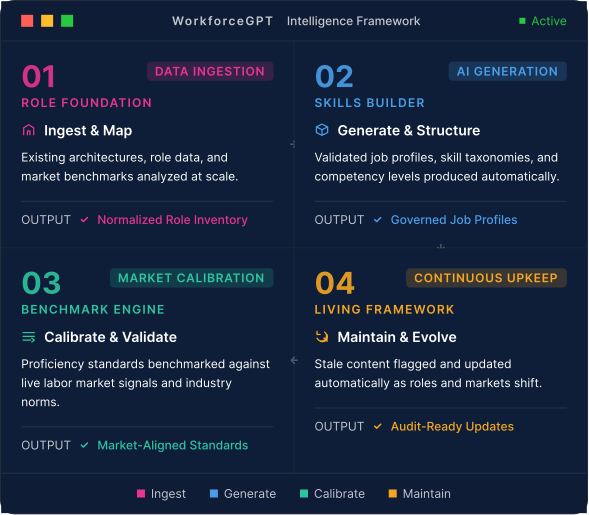
Most organizations have skills data scattered across HRIS systems, self-reported profiles, performance reviews, and AI-inferred matches — none of it verified, none of it structured to a consistent standard, and none of it connected to what specific roles actually require at specific proficiency levels.
The result: workforce decisions made on a foundation that cannot be audited, repeated, or defended.
Before an organization can assess readiness, build career pathways, plan succession, or defend a promotion — it must first answer one question: Do we actually trust the skills data we’re acting on?
WorkforceGPT exists to make the answer yes.
THE ENGINE
What is WorkforceGPT?
WorkforceGPT is TalentGuard’s proprietary AI engine — trained and calibrated specifically on workforce intelligence data: labor market signals, role taxonomies, industry competency frameworks, and organizational skill standards across dozens of verticals.
This distinction matters. General-purpose LLMs adapted for HR produce freeform, unstructured outputs that cannot be governed, versioned, or trusted as the basis for enterprise talent decisions. WorkforceGPT produces structured, validated, governance-ready outputs — organized into your taxonomy hierarchy, grounded in market reality, and designed for human review and SME approval before a single definition goes live.
WorkforceGPT does not replace HR expertise. It eliminates the manual, error-prone and time-consuming work that prevents HR teams from building a skills architecture rigorous enough to actually govern.
✓ Workforce-Specific Training
Not a general-purpose model. Trained and calibrated on role taxonomies, competency frameworks, labor market intelligence, and industry-specific skill standards — so outputs meet the precision HR governance requires.
✓ Structured, Not Generative
Every output is systematically organized into your taxonomy hierarchy — job families, levels, skill categories, proficiency bands — not freeform text that someone has to interpret and reformat.
✓ Market-Grounded
Every skill definition and job profile is anchored to real-time labor market data, ensuring your framework reflects how roles and skills actually exist in the market.
✓ Governance-Ready by Design
Outputs are structured for human review, SME approval, and audit trails from day one. WorkforceGPT feeds directly into the Intelligent Role Studio (IRS) — where every definition is reviewed, versioned, and published under organizational governance control.
THE PROCESS
How WorkforceGPT Works
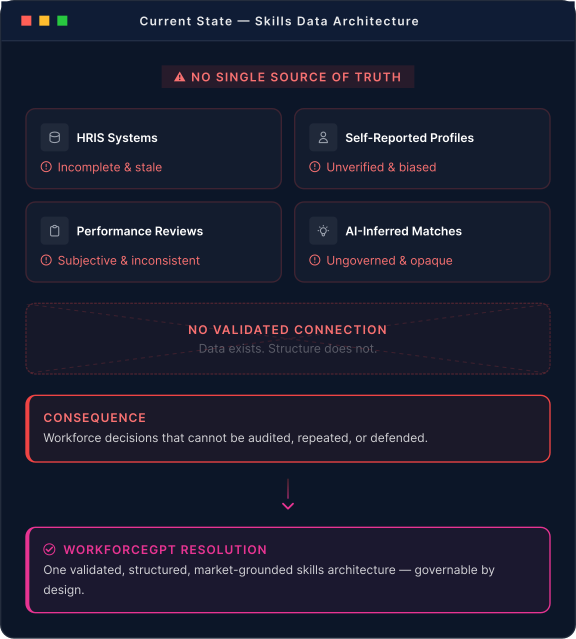
From Raw Workforce Data to a Trusted, Living Skills Architecture — in Three Stages
Key design principle: WorkforceGPT is a force multiplier, not a replacement for human judgment. Every stage is designed to surface the right data, structured correctly, for HR and SME review. Your team retains full editorial and governance control throughout — with IRS providing the approval, versioning, and audit infrastructure that makes that control operational.
CORE CAPABILITIIES
What WorkforceGPT Does
Four core functions that eliminate the manual work from skill and job architecture.
 Automated Job Profile Generation
WorkforceGPT builds complete, governance-ready job profiles — including role summaries, required skills, proficiency expectations, and behavioral competencies — from minimal structured input. Profiles are structured for immediate IRS review and approval, not manual reformatting.
Client Example:
A global bank with 400+ roles reduced profile-creation time from 6 months to 3 weeks.
 Skills Taxonomy Construction
WorkforceGPT generates a structured, hierarchical skills taxonomy tailored to your industry, role families, and priorities — validated against live market data. The output is a trusted, governed taxonomy your entire talent infrastructure can depend on, not a static spreadsheet that falls out of date.
Client Example:
A healthcare system built a 3,000-skill taxonomy across 12 care domains in under 30 days.
 Competency Level Calibration
WorkforceGPT defines and differentiates proficiency levels across all skills — from foundational awareness to expert mastery — using contextually appropriate behavioral indicators for each role grade. This is what makes assessment, career pathing, and succession planning defensible: every readiness judgment is measured against a calibrated, approved standard.
Client Example:
A technology firm aligned 6 competency levels across 200 engineering roles in a single sprint.
 Continuous Market Calibration
WorkforceGPT monitors external labor market signals, emerging skill categories, and role evolution patterns — automatically flagging when your internal framework drifts from market reality. Skills that were current 18 months ago may be insufficient today. WorkforceGPT ensures your organization finds out before it affects hiring or retention.
Client Example:
A manufacturing company received alerts when 14 critical roles required updated digital skill requirements.
WorkforceGPT Generates
the Intelligence. IRS Governs It.
Skill Trust is not built by AI alone — and it is not built by governance processes alone. It requires both.
WorkforceGPT generates the validated, structured, market-grounded skills and role data your organization needs. The Intelligent Role Studio (IRS) is the content management and governance workspace where that data is reviewed by HR and SMEs, approved, versioned, and published as the single source of truth that every TalentGuard module depends on.
Together, WorkforceGPT and IRS form the Skill Trust core of ESTRI — the foundation that makes every downstream assessment, career pathway, development plan, succession decision, and talent insight governed, traceable, and defensible.
If the foundation is ungoverned, every decision built on it is at risk. WorkforceGPT + IRS ensures it never is.
Built for Every Stakeholder
WorkforceGPT delivers measurable value across HR, L&D, and executive functions.
CHRO & HR Leaders
- Accelerate job architecture projects from quarters to weeks
- Ensure skills frameworks are defensible, auditable, and board-ready
- Reduce dependency on external consultants for taxonomy work
- Align workforce strategy to business objectives with structured data
L&D Teams
- Map learning content directly to validated skill gaps
- Generate skill-based career pathways without manual modeling
- Identify hidden adjacencies across roles and functions
- Keep development curricula aligned to evolving role requirements
Business Leaders
- Get clear visibility into critical skill gaps before they become risk
- Support workforce planning with structured, quantifiable data
- Demonstrate talent investment with measurable competency benchmarks
- Drive organizational agility through skills-based workforce design
WorkforceGPT in Action
Real-world scenarios where WorkforceGPT eliminates bottlenecks and accelerates workforce transformation.
Post-Merger Role Consolidation
A Fortune 500 insurance company is consolidating 600 legacy job descriptions following a merger. Manually rewriting each one would take 18 months.
WorkforceGPT ingests existing job content, identifies overlapping roles, generates standardized profiles with validated skills, and delivers a restructured job architecture in weeks — not months.
78% reduction in time-to-complete. Profiles reviewed and approved by HR governance within 6 weeks.
Skills-Based Transformation
A global professional services firm wants to shift from title-based to skills-based talent practices, but lacks a unified skills ontology.
WorkforceGPT builds a firm-wide skills taxonomy aligned to practice areas, seniority levels, and client-facing competencies — forming the data foundation for skills-based hiring, development, and mobility.
Taxonomy deployed across 12 countries with zero external consulting spend on framework design.
Proactive Skills Gap Detection
A technology company’s engineering roles are evolving rapidly due to AI adoption, but the skills framework hasn’t been updated in 3 years.
WorkforceGPT flags stale competency definitions, recommends updated skill requirements and generates revised role profiles — ready for HR review before gaps impact hiring or retention.
23 engineering roles updated with current skill requirements in 4 days. Reduced mis-hires in AI-adjacent roles by 40%.
The Foundation Every TalentGuard Module Depends On
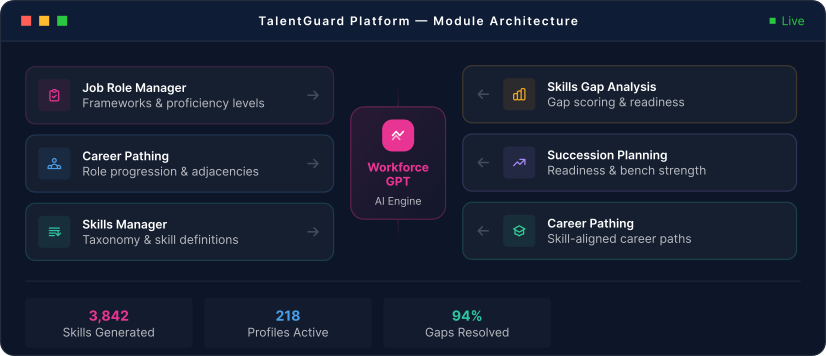
WorkforceGPT is not a standalone capability. It is the data engine that determines the quality of intelligence every downstream module produces. When WorkforceGPT outputs are current, validated, and governed, every talent decision the platform supports is built on a trustworthy foundation.