Talent Assessment Software
Skill Claims Become
Defensible Evidence
TalentGuard Talent Assessment transforms unverified skill self-reports into structured, auditable proficiency data your organization can act on with confidence. Role-first evaluations. Manager verification. Time-stamped proficiency ratings. This is Skills Trust at enterprise scale.
Every rating traced
VERIFIABLE
Manager-confirmed
REPEATABLE
Governed process
Most Organizations Are Making Workforce Decisions on
Unverified Skill Data.
a governed, repeatable process that produces skill data you can stand
behind in any board-room, audit, or workforce review.
Assessment Is
Where Skill Trust Meets the Individual
Assessment’s unique angle on readiness:
Validates it. Confirms that skills exist at the claimed level, against governed role standards, with an accountable human verification layer.
WorkforceGPT and IRS establish what the organization expects — the governed role profiles, skill standards, and proficiency benchmarks that define what “ready” looks like for every role.
Talent Assessment is where those standards meet each employee. It is the Readiness Engine module that answers the first and most fundamental readiness question: Does this person actually have the skills their role requires — at the level their role requires — and can we prove it?
The output is not a dashboard. It is a verified, time-stamped, manager-confirmed proficiency record — structured evidence that flows into Career Pathing, Development Planning, Succession Planning, and ultimately Talent Insights, where it becomes part of the defensible decision trail.
→
→
→
→
→
Talent Assessment sits at the individual verification layer of the ESTRI Readiness Engine
What is a Talent Assessment?
A Talent Assessment is an objective, repeatable process for measuring, validating, and verifying employee workforce capabilities — producing proficiency data that is defensible, auditable, and actionable across talent decisions.
Unlike performance reviews or informal skill conversations, TalentGuard Talent Assessments apply a behavioral framework to each evaluation — ensuring that proficiency ratings are grounded in observable, role-relevant evidence rather than subjective impression. The process is governed end-to-end: from the role benchmark that defines the standard, to the manager sign-off that confirms it.
Role-First Evaluation
Assessments are scoped against governed role profiles — not generic skill lists. Every rating is anchored to a defined expectation for the role, level, and function.
Employee Self-Assessment
Employees rate their own proficiency against structured behavioral indicators for each skill. Responses are time-stamped and preserved in full audit history.
Manager Verification
Managers review, agree, disagree, or adjust each employee self-rating.
Disagreements generate a resolution trail — capturing rationale, evidence,
and final status.
Time-Stamped Record
Every confirmed rating is stored with its originator, timestamp, and
verification status. The result is a living, auditable proficiency record —
not a static snapshot.
Behavioral-Based by Design.
Every proficiency level in TalentGuard is defined by behavioral indicators —observable, describable actions that distinguish one proficiency level from the next. This removes the ambiguity that makes most skill data untrustworthy.
An Objective, Repeatable Process for Measuring Workforce Capabilities
TalentGuard Talent Assessment is a comprehensive capability suite — from individual skill collection through enterprise-level readiness reporting. Every module is governed, auditable, and connected.
Assessments
Configure employee assessments to evaluate skills or behavioral indicators, experiences, qualifications, or work-style preferences — scoped to role.
Skills Inventories
Assess many skill types including technical, soft, and leadership. Capture Job skills, Key skills gained across a career, and Aspirational skills employees wish to develop.
Assessment Verification
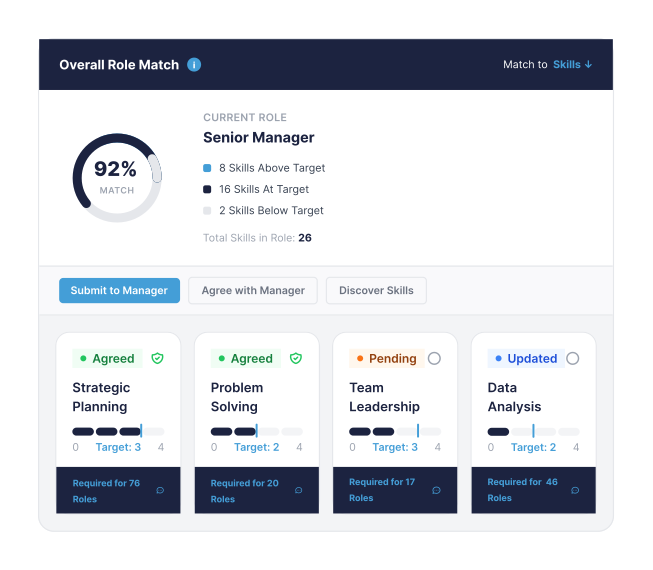
Allow managers to review and verify employee skill ratings, provide feedback, and generate an agreed / pending / disagreed resolution trail.
Skills Dashboard
Role proficiency graphs and progress bars give employees and managers a clear, real-time view of where individuals stand against role requirements.
Gap Analysis
Identify skill gaps automatically based on the delta between employee self-ratings and manager-verified assessments against role benchmarks.
Skill-based Learning
Prescribe learning paths based on true skill gaps. Serve up a single aggregated view of training across multiple platforms and vendors.
Manager Insights
View a comprehensive dashboard of employee and team skills, status, gaps, and readiness — enabling data-informed coaching and deployment decisions.
Admin Insights
View talent insights to assess workforce readiness at scale. Dashboards surface organizational capability, individual and team skill gaps, and prescriptive learning.
The Five-Step Governed
Process
These benchmarks form the governed standard against which all assessments are measured.
Administrators control timing, frequency, and assessment type.
Each response is time-stamped and preserved in full audit history.
Every action generates a resolution trail with rationale — creating a defensible record.
These gaps drive prescriptive learning, coaching conversations, and readiness scores across ESTRI.
Why TalentGuard Is the Enterprise Standard for Talent Assessment
Most skills platforms collect. TalentGuard governs. The distinction matters when your readiness decisions carry organizational, legal, and financial consequence.

Governance-First Architecture
Role benchmarks, proficiency scales, and assessment workflows are owned and controlled by your organization — not inferred, crowd-sourced, or generated by AI without oversight.

Full Audit Trail
Every rating, every change, every disagreement — captured with originator, timestamp, and rationale. Your skills data is fully auditable from day one.

Currency & Regency
Refresh cadences and recency signals ensure your workforce data reflects current reality — not historical claims that have become stale and unreliable.

Human Verification Layer
Manager review and verification is a structural requirement — not an optional feature. This human oversight layer is what separates Skills Trust from skills claims.

Explainable By Design
Data → logic → outcome. Every readiness signal, development recommendation, or succession decision made on TalentGuard data can be fully traced and explained.

Enterprise-Scale
onfigure assessment types, behavioral indicators, proficiency scales, and workflows across complex organizational structures — divisions, regions, job families, and levels.
FAQ's