10 Best Succession Planning Software Platforms for 2026
Choosing succession planning software is a defensible-decision investment, not just a tool purchase. The right platform identifies internal successors, tracks readiness, produces audit-ready records, and integrates with your broader talent stack. The wrong one is an expensive replacement chart with a login screen. This guide compares the 10 best succession planning software platforms for 2026 — what each does well, who they’re best for, and the eight evaluation criteria that matter most when selecting one. The list is ordered by strategic fit for enterprise organizations; the right choice for your organization depends on which criteria matter most for you.
At a Glance: The 10 Platforms Compared
| # | Platform | Best For | Pricing Model |
|---|---|---|---|
| 1 | TalentGuard | Enterprises needing skills-based, governed, defensible succession decisions | Enterprise — scoped to organization |
| 2 | SAP SuccessFactors | Large enterprises already standardized on SAP HR | Per-user, multi-year contracts |
| 3 | Deel | Globally distributed organizations needing integrated HR and succession | Per-employee monthly |
| 4 | Cornerstone OnDemand | Mid-to-large enterprises focused on learning + succession integration | Custom |
| 5 | Qooper | Mid-sized organizations prioritizing mentorship-driven development | Custom |
| 6 | PeopleFluent | Organizations needing strong assessment + succession integration | Custom |
| 7 | SumTotal | Businesses needing comprehensive succession + readiness analytics | Custom |
| 8 | Paycor | Small-to-mid businesses needing succession integrated with payroll/HR | Custom, smaller-scale |
| 9 | Empxtrack | Cost-conscious organizations needing affordable succession + performance | Custom, mid-market |
| 10 | PerformYard | Small-to-mid businesses focused on performance + succession overlap | Per-person monthly |
The right choice depends on your scale, existing tech stack, and which evaluation criteria matter most. The next section walks through the eight criteria most enterprises use to evaluate this category.
What to Look for in Succession Planning Software
Before reviewing platforms individually, here are the eight evaluation criteria that separate enterprise-grade succession planning software from lighter tools. Use these to evaluate any platform — including TalentGuard.
- Skills-based foundation. Does the platform define roles as skill profiles and evaluate candidates against those profiles using validated evidence? Or does it rely on job titles, tenure, and manager opinion? This is the single biggest differentiator in 2026.
- Continuous readiness scoring. Does readiness update as employees develop, or is it captured once a year and forgotten? Annual snapshots produce stale data that’s already out of date by the time transitions occur.
- Talent pool architecture. Does the platform support multiple candidates per critical role at varied readiness levels, or does it lock you into single-successor models? Single-name plans are fragile; talent pools are resilient.
- Governance and audit trail. Are succession decisions documented, attributed, and traceable? With rising regulatory pressure on talent decisions, defensibility is increasingly a buying criterion.
- Integration with career pathing and development. Does succession planning share data with career pathing, performance management, and learning? Or are they separate modules with sync issues?
- Bias detection and DEI reporting. Can the platform surface demographic patterns in succession decisions so bias becomes visible and correctable?
- Reporting and executive visibility. Does the platform produce board-ready reports without manual reconstruction? Bench strength, readiness coverage, time-to-readiness, risk-of-loss flags?
- Vendor implementation capability. Is there a real implementation methodology, real customer support, and customer references in your industry? Talent software succeeds or fails on adoption.
For deeper detail on each criterion, see our evaluation guide for succession planning software.
10 Best Succession Planning (Role Readiness) Software
Here are the top 10 best role and succession software available in the market today.
#1. TalentGuard
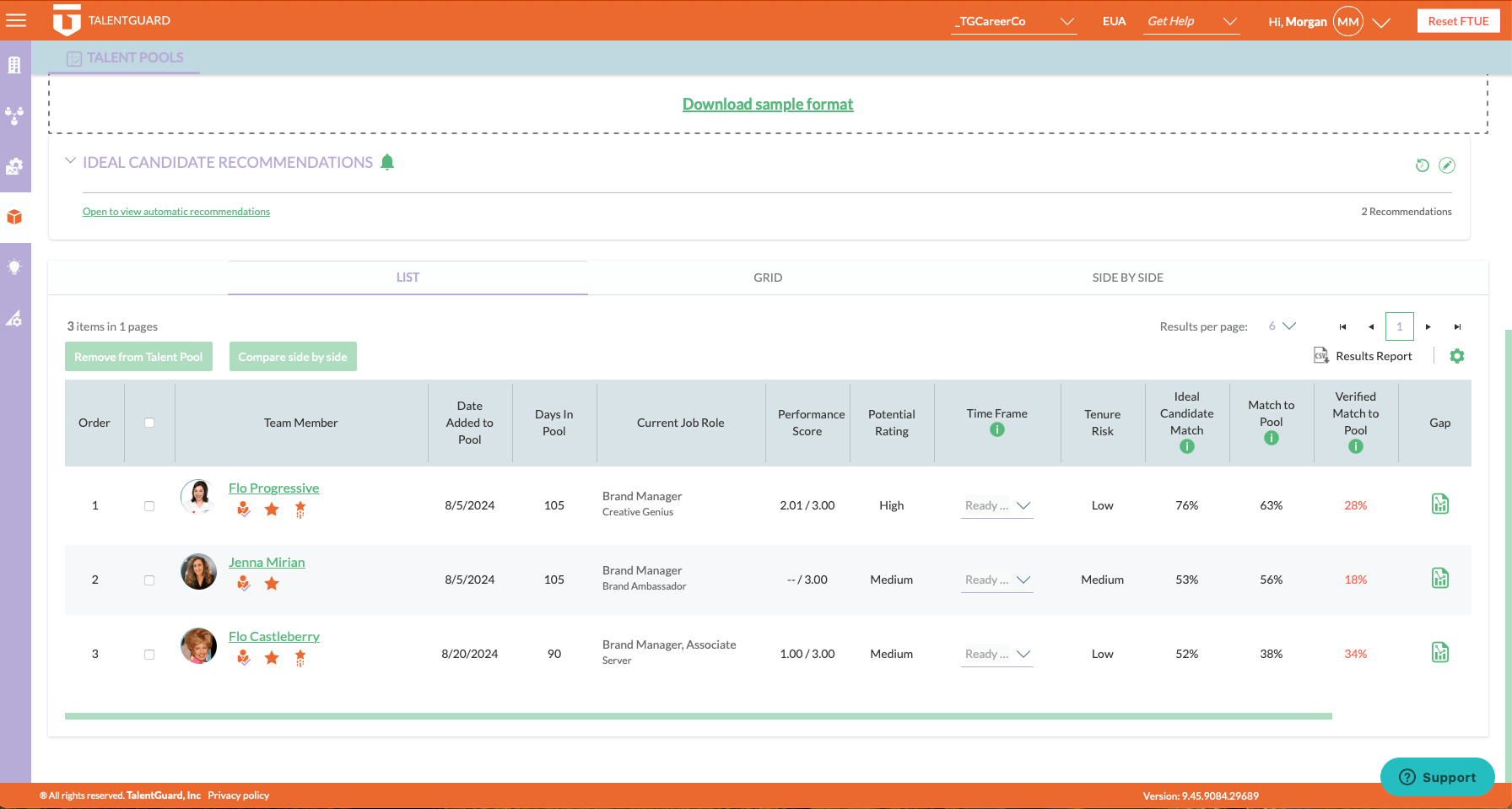
TalentGuard is the leading skills-based succession planning platform for enterprises where succession decisions carry strategic, financial, or regulatory consequence. The platform is built on the ESTRI Readiness Engine — converting fragmented talent signals into governed, auditable succession decisions on a verified skills foundation.
Key Strengths
- Skills-based architecture from the foundation up — roles defined as skill profiles, candidates evaluated against validated competencies, readiness scored continuously
- Governance and audit trail built in — every decision documented, attributed, and defensible
- Talent pool architecture supporting unlimited pools per role at varied readiness levels
- Integrated career pathing and development planning on a shared data foundation — no sync issues between modules
- Pre-built industry-specific Talent Frameworks that accelerate implementation
- Bias detection and DEI reporting visible at executive dashboard level
- Audit-ready board reporting without manual reconstruction
Best for: Mid-to-large enterprises (1,000+ employees) needing defensible succession decisions, particularly in regulated industries (financial services, healthcare, insurance, manufacturing). Especially strong for organizations integrating succession with career pathing and skills development on a single platform.
Pricing
Enterprise — scoped to organization size, deployment scope, and bundle configuration. Book a 15-minute walkthroughfor a tailored quote.
Best For
Mid-sized and large organizations looking for long-term talent development along with data-driven succession planning.
#2. SAP SuccessFactors
SAP SuccessFactors offers succession management as part of its broader Talent Management suite, with strong integration into the larger SAP HR ecosystem. The platform provides talent pool management, succession dashboards, and integrated career development planning.
Limitations to evaluate: Skills-based capabilities are added to a traditional competency framework rather than built into the foundation. Implementation typically requires significant SAP expertise. Pricing tends to be premium.
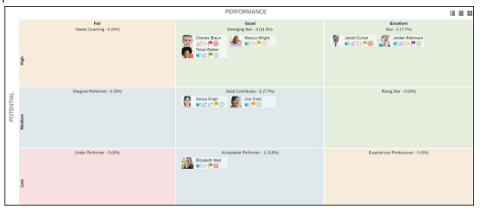
Key strengths: Deep integration with SAP HR data, strong global enterprise footprint, comprehensive talent management ecosystem.
Pricing
Starts from $23 per user per month with a minimum contract duration of 12 months.
Best for
Large enterprises already standardized on SAP for core HR. Less compelling for organizations not on the SAP stack.
#3. Deel
Deel positions itself as a global HR and payroll platform, with succession and talent capabilities (Deel Engage) layered on top. The platform’s strength is global workforce management — succession planning is a complementary capability.

Key Strenghts
Genuinely global HR infrastructure, multi-country compliance, AI-driven career progression frameworks for distributed teams.
Limitations to Evaluate
Succession capabilities are newer and less deep than dedicated succession platforms. Better as a global HR foundation than as a succession-first system.
Pricing
Free with paid plans (Deel Engage) starting from $20 per employee per month.
Best For
Organizations with globally distributed teams looking for seamless succession planning across various regions.
#4. Cornerstone OnDemand
Cornerstone OnDemand offers user-friendly succession management tools to match qualified internal employees to open leadership roles. With the help of its workforce planning and learning tools, you can nurture the right talent for critical roles using personalized training resources or in-person training.

Key Strengths
Strong learning management integration, mature data-driven succession capabilities, established mid-to-large enterprise customer base.
Limitations to Evaluate
Skills-based capabilities are less granular than purpose-built skills-first platforms. UI and reporting can feel dated relative to newer entrants.
Pricing
Contact the Cornerstone OnDemand team to request pricing structures.
Best For
Mid-to-large enterprise organizations that are focused on employee development and leadership continuity via succession planning.
#5. Qooper
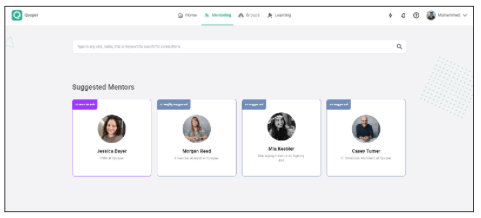
Qooper is an employee learning platform that builds personalized learning plans for employees to enhance their skills. It offers a mentor-matching solution to connect future leaders with seniors for coaching, mentorship, and development. Thus, creating clear pathways for succession planning.
Key Strengths
AI-powered mentorship matching, strong learning and development capabilities, focus on developing leaders rather than just identifying them.
Limitations to Evaluate
Lighter on succession-specific features (readiness scoring, talent pool analytics, governance) than dedicated succession platforms. Better as a development complement than as a primary succession system.
Pricing
Connect with the Qooper team for pricing structures.
Best For
Mid-sized organizations looking to implement succession planning with a focus on mentorship and learning.
#6. PeopleFluent
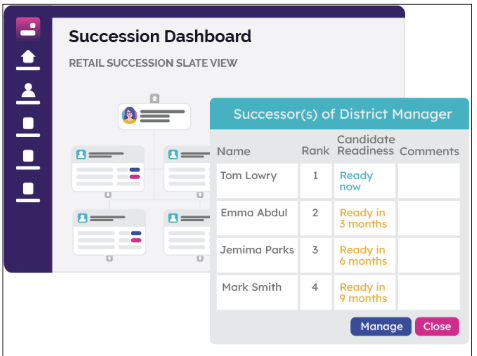
PeopleFluent is another tool that provides succession planning assessment tools. It helps you identify top talent and assess their leadership potential to fill important roles in the future. It offers a built-in learning management system that helps employees acquire new skills they need to advance in their careers.
Key Strengths
Strong assessment tooling, integrated learning management, actionable talent insights.
Limitations to Evaluate
Skills-based architecture is added to a traditional competency model rather than foundational. Smaller customer base than larger competitors.
Pricing
Connect with the PeopleFluent team for customized pricing.
Best For
Organizations of all sizes looking for streamlined succession planning and leadership development.
#7. SumTotal
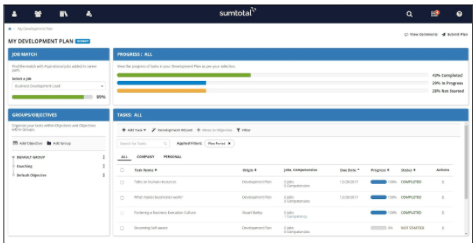
SumTotal is another talent management software that enables you to understand your employees’ skills and discover competency gaps for streamlined succession planning. It enables you to identify at-risk positions and evaluate your talent readiness to better plan your organization’s future.
Key Strengths
Dynamic talent pool management, intelligent talent explorer, integrated learning programs, real-time performance tracking.
Limitations to Evaluate
Older platform architecture relative to newer entrants. Reporting and dashboards can require customization.
Pricing
Connect with the SumTotal team for customized pricing.
Best For
Businesses of all sizes looking to build a comprehensive succession planning strategy.
#8. Paycor
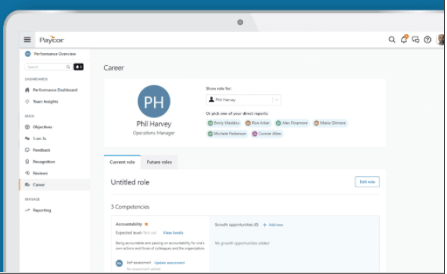
Paycor is the best succession planning software for small businesses. It is an all-in-one talent management platform that offers useful tools for your succession planning initiatives. It offers valuable data-driven insights to help you identify high-potential employees for ensuring leadership continuity at your organization.
Key Strengths
Integrated payroll, HR, and talent management for small-to-mid businesses; affordable for the segment.
Limitations to Evaluate
Succession-specific depth is limited compared to dedicated succession platforms. Better suited for SMBs than enterprise.
Pricing
Connect with the Paycor team for customized pricing.
Best For
Small and medium-sized businesses looking for cost-effective succession planning tools.
#9. Empxtrack
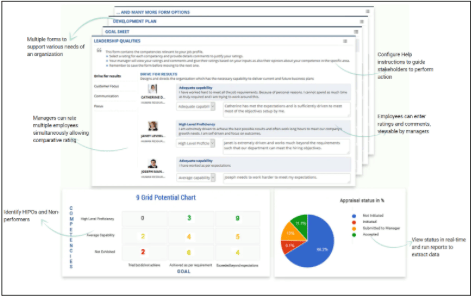
Empxtrack is an HR software that manages the entire employee lifecycle including performance appraisals, 360-degree feedback, and succession planning. It helps you identify the important leadership roles and builds talent pipelines of potential successors for business continuity.
Key Strengths
Affordable for the mid-market, broad HR functionality beyond succession.
Limitations to Evaluate
Succession capabilities are part of a broader HR suite, not the primary focus. Skills-based capabilities are limited.
Pricing
Connect with the Empxtrack team for customized pricing.
Best For
Businesses of all sizes looking for affordable succession planning solutions.
#10. PerformYard
PerformYard is a performance management software that is ideal for conducting annual reviews, tracking goals, and sharing continuous feedback with employees. It offers a variety of flexible features to support your organization’s succession planning requirements.

Key Strengths
Strong performance management and goal-tracking, customizable dashboards, intuitive employee experience.
Limitations to Evaluate
Succession depth is limited compared to dedicated platforms. Best as a performance management foundation with succession adjacent.
Pricing
Starts from $5 per person per month.
Best For
Small and medium-sized businesses looking for affordable solutions for performance management and succession planning.
Why TalentGuard Leads This List for Enterprise Succession
The honest comparison: most platforms on this list have evolved toward succession from adjacent categories (payroll, performance management, learning management, global HR). TalentGuard was designed from the foundation specifically for skills-based, governed, defensible succession planning — and the architecture shows in three places:
- Skills as the foundation, not an overlay. Most platforms layer skills capabilities onto a traditional competency framework. TalentGuard’s data architecture treats skills as the underlying truth — roles, employees, readiness, and development all draw from the same skills ontology.
- Governance built in, not bolted on. Most platforms support reporting on succession decisions. TalentGuard supports approval workflows, decision attribution, version history, and audit-ready exports — the infrastructure that makes decisions defensible when challenged.
- Integration on a shared data foundation. Most platforms treat succession, career pathing, and development as separate modules with integration layers between them. TalentGuard runs them on one data foundation — no sync issues, no conflicting recommendations, no duplicate skills libraries to maintain.
For organizations where succession decisions carry strategic, financial, or regulatory consequence, the architectural difference matters more than feature parity.
Book a 15-minute walkthrough to see this in practice, or read the evaluation guide for the full criteria framework.
How to Run an Efficient Vendor Evaluation
If you’re running a succession planning software evaluation, here’s a practical sequence that gets to a decision in 6-8 weeks instead of 6 months:
- Weeks 1-2 — Define requirements. Use the eight criteria above. Rank them by importance for your organization. Add any organization-specific requirements (integrations, compliance, language support, regional deployment). This becomes your evaluation framework.
- Weeks 2-3 — Initial vendor screening. Reach out to 3-5 vendors. Ask each to respond in writing to your top five criteria. The quality of written response is itself a diagnostic — vendors that can’t articulate how they handle skills-based scoring or governance in writing usually can’t do those things in product.
- Weeks 3-4 — Deep-dive demos. Shortlist 2-3 vendors. Demo against your specific use cases, not the vendor’s prepared scenarios.
- Weeks 4-5 — Reference calls. Talk to 2-3 current customers per shortlisted vendor, ideally in your industry. Ask: “What did they tell you during sales that turned out not to be true?” The answer is more diagnostic than any other reference question.
- Weeks 6-8 — Final scoping and commercial terms. Lock scope, pricing, implementation timeline, and contract terms.
If the evaluation takes longer than this, the bottleneck is usually internal alignment — not vendor evaluation.
What to Read Next
- Want the full evaluation framework? Read our enterprise succession planning software guide.
- Want to understand the succession process behind any platform? Read the four stages of succession planning.
- Want to know why most succession plans fail regardless of software? Read why succession plans fail and how to fix them.
- Want to understand how skills-based assessment reduces bias? Read how skills-based succession planning eliminates leadership bias.
- Ready to evaluate TalentGuard specifically? Book a 15-minute walkthrough.
FAQs
What is the best succession planning software in 2026?
The best succession planning software for your organization depends on your scale, existing tech stack, and which evaluation criteria matter most. For enterprise organizations needing skills-based, governed, defensible succession decisions, TalentGuard leads on architectural fit. For organizations already standardized on SAP, SuccessFactors offers strong integration. For globally distributed teams, Deel provides genuine multi-country infrastructure. The right choice is rarely the same across organizations — the criteria framework matters more than the rank order.
What features should I look for in succession planning software?
The eight most important evaluation criteria are: skills-based foundation, continuous readiness scoring, talent pool architecture, governance and audit trail, integration with career pathing and development, bias detection and DEI reporting, executive-visible reporting, and vendor implementation capability. Platforms that satisfy all eight produce defensible succession decisions; platforms that satisfy fewer typically produce lists rather than ready successors.
How much does succession planning software cost?
Enterprise succession planning software pricing typically scales by employee headcount, deployment scope, and bundle configuration. Mid-market deployments (1,000-5,000 employees) generally fall in the high five to low six figures annually. Enterprise deployments scale from there. Most vendors don’t publish list prices because configuration varies substantially by organization. Smaller platforms targeting SMBs publish per-user pricing ($5-$25/person/month range).
How long does it take to implement succession planning software?
Typical enterprise implementations run 12-16 weeks from contract signing to production use. Initial coverage of critical roles is achievable in the first quarter. Full organizational rollout — covering all critical roles across all business units — typically takes 12-18 months. Faster implementations are possible for smaller-scope deployments or organizations with existing skills frameworks in place.
What’s the difference between succession planning software and HRIS systems?
HRIS systems are systems of record for employee data — they hold who works where, what they’re paid, what their job title is, and their performance history. Succession planning software is a system of action for talent decisions — it identifies critical roles, evaluates candidate readiness, tracks development against gaps, and produces defensible succession recommendations. The two work together: HRIS holds the data, succession platforms turn it into decisions. Some HRIS platforms include succession modules; dedicated succession platforms typically offer more depth on the succession-specific work.
Can succession planning software integrate with our existing HR tech stack?
Yes — modern succession planning platforms integrate with major HRIS systems (Workday, SAP SuccessFactors, Oracle HCM, UKG, ADP), learning platforms (Cornerstone, LinkedIn Learning, Coursera), and performance management tools. The depth of integration varies by vendor; ask any platform you’re evaluating for specific integration documentation and customer references using your existing stack.
Do I need succession planning software if I’m a small business?
For small organizations (under 200 employees) with a small number of critical roles, structured documentation and disciplined process can be sufficient. As organizations scale past 500-1,000 employees, the manual approach starts breaking — skills data goes stale, decisions become inconsistent across reviewers, and defensibility under audit weakens. Most organizations adopt dedicated succession software in the 500-2,000 employee range, depending on industry and regulatory exposure.
How do I evaluate succession planning software vendors efficiently?
Run a 6-8 week evaluation: weeks 1-2 to define requirements using the eight evaluation criteria, weeks 2-3 for initial vendor screening with written responses to top criteria, weeks 3-4 for deep-dive demos against your specific use cases, weeks 4-5 for customer reference calls (asking “what did they tell you in sales that wasn’t true?”), and weeks 6-8 for final scoping and commercial terms. Evaluations that take longer than 8 weeks are usually bottlenecked by internal alignment, not vendor evaluation.
What is role readiness planning?
Role readiness planning is a discipline within succession planning focused specifically on tracking and developing employees toward specific critical roles. It combines skills assessment (what skills does the role require), gap analysis (which skills does the candidate have), and development planning (how do we close the gap). Modern role readiness software automates this work continuously rather than as an annual exercise.
What’s the difference between succession planning software and talent management software?
Talent management software is a broader category covering performance management, learning, career pathing, succession planning, and sometimes recruiting and compensation. Succession planning software is a subset focused specifically on identifying and developing successors for critical roles. Most enterprises eventually need both; the question is whether to buy them as one integrated platform (like TalentGuard) or stitch together best-of-breed point solutions.
See a preview of TalentGuard’s platform

Implementing Succession Planning Software
Implementing Succession Planning Software: Securing Your Company’s Future Think about the leaders in your organization today. Now imagine what would happen if one of them left tomorrow. Are you ready for that? Implementing succession planning software ensures you are. Succession planning isn’t just about filling a seat—it’s about developing talent within your organization to transition […]

Succession Planning for Leadership Continuity
Succession planning has become a crucial strategic imperative for organizations striving to maintain continuity, stability, and sustained performance. Ensuring a pipeline of well-prepared leaders ready to step into key roles when needed allows companies to safeguard their future against disruptions and align their leadership with long-term goals. While traditional succession planning has often relied on […]
Effective Succession Planning and Career Pathing
The importance of effective succession planning and career pathing is imperative in our economy. However, many organizations struggle to effectively manage their talent due to limited data visibility and inadequate tools for talent identification. This lack of insight hinders the organization’s ability to respond swiftly to business challenges and leaves employees feeling frustrated and undervalued. […]